Skip to content
 Google discontinued free vehicle listings (Vehicles for Sale) inside Google Business Profiles in November 2025 (KGI Dealer Solutions reports November 12; Google issued no dated announcement). Google had deprecated the VehicleListing structured-data type that powered free inventory display from dealer websites earlier in 2025. Neither change ends car inventory visibility on Google – the channels changed, not the opportunity.
Google’s vehicle listings: The “Cars for Sale” / “Vehicles for Sale” display ran free inside Google Business Profiles from its 2021 beta, broadened to all VIN inventory in early 2023, until its discontinuation in late 2025.
The feature displayed vehicle make, model, price, mileage, and availability directly within a dealership’s GBP panel without requiring paid ad spend. This article states precisely what ended, what remains operational, and the 6 prioritized actions that protect and rebuild inventory visibility across Google, third-party marketplaces, and AI-powered search in 2026.
Key Takeaways
- Google discontinued the free “Vehicles for Sale” / “Cars for Sale” display in Google Business Profiles in late 2025 (KGI Dealer Solutions reports November 12).
- Google deprecated the VehicleListing structured-data type; Search Console stopped reporting on the type by the end of 2025.
- The deprecation does not cause ranking drops or Search Console errors. Old markup becomes inactive, not penalized.
- Google Vehicle Ads (paid, inventory-fed) are the closest functional replacement for the discontinued free display.
- Organic SEO on vehicle detail pages (VDPs) and local landing pages remains fully operational.
- Third-party marketplaces (Cars.com, Autotrader, Facebook Marketplace), GBP engagement, and AI search visibility are all active channels.
- Dealers dependent on the free display as a primary channel face the highest exposure from this change.
What Did Google Change with Vehicle Listings?
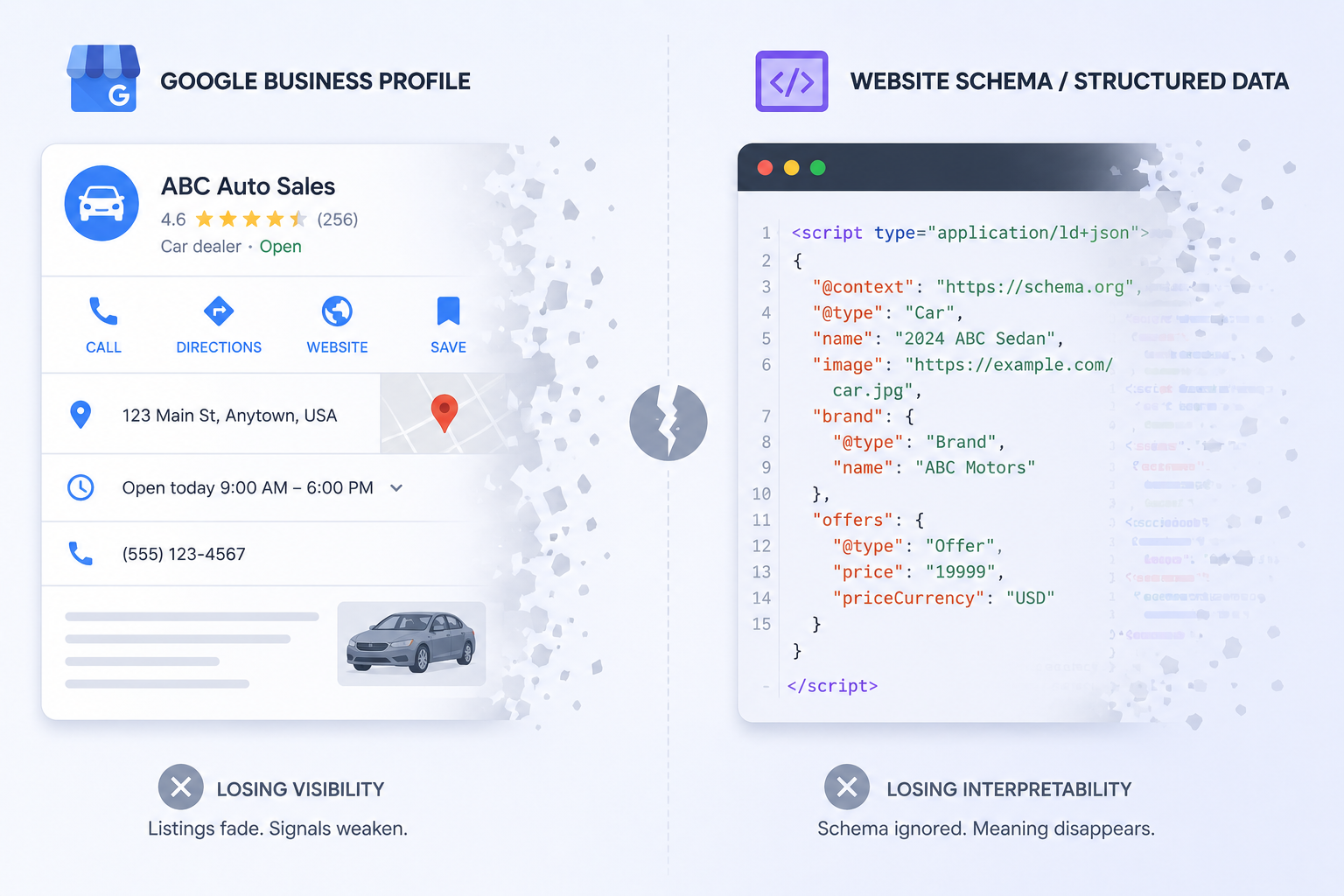
Google made 2 distinct changes in 2025: Google discontinued the free Vehicles for Sale display in Google Business Profiles and deprecated the VehicleListing structured-data type used to feed inventory from dealer websites to that display.
The first change removed the free inventory panel from GBP entirely. Dealers and operators on DealerRefresh forums began reporting inventory disappearing from Business Profiles throughout mid-2025. KGI Dealer Solutions confirmed the discontinuation date as November 12, 2025, and PureCars published confirming coverage in December 2025.
The second change involved schema markup. Google deprecated the VehicleListing structured-data type, the markup specification that allowed dealers to annotate individual inventory pages so Google could surface them in the free display without a formal data feed. As part of the same structured-data streamlining, Google removed VehicleListing from Search Console reporting tools and API data by the end of 2025, according to Search Engine Land’s coverage of Google’s structured-data type retirements (September 2025).
These 2 changes are related but operationally distinct. Dealers who used feed-based inventory programs through approved providers saw a different experience from dealers who relied on the no-feed VehicleListing markup path.
How We Got Here
This wasn’t a single switch-flip, it rolled out in stages:
- October 2024: Dealers and inventory providers begin reporting vehicle listings sporadically disappearing from Business Profiles.
- Mid-2025: Google formally deprecates the VehicleListing structured-data type as part of a broader structured-data streamlining.
- September 2025: Google drops Search Console reporting for the VehicleListing type.
- Late 2025: The free “Vehicles for Sale” display is discontinued in Business Profiles (KGI reports November 12; Google issued no dated announcement), and Google states the organic auto-listings feature and feed processing are being stopped.
Roughly 14,000 OEM-affiliated dealers among about 18 million US Business Profiles were affected.
What Ended vs. What Still Works
The table below defines the 4 discontinued elements and the 4 operational channels that remain active for inventory visibility on Google.
| What Google Ended | What Still Works |
| Free “Vehicles for Sale” / “Cars for Sale” display in Google Business Profiles | Google Vehicle Ads, paid, inventory-fed listings appearing at the top of search results |
| No-feed VehicleListing structured-data type as a display mechanism | Paid Google Vehicle Ads feeds via Merchant Center (note: the free organic vehicle-listings feed is being sunset too, the surviving feed path is paid) |
| Search Console reporting and API data for the VehicleListing type | Organic SEO on vehicle detail pages (VDPs) and local landing pages |
| Free inventory placement without ad spend | Third-party marketplaces, social channels, email, and Google Business Profile engagement |
The core distinction is between free passive display (ended) and active visibility programs (operational). Google removed the zero-cost inventory surface. Google did not remove inventory discoverability.
Why Did Google Remove Free Vehicle Listings?
Google removed free vehicle listings for 3 operational reasons: low vendor adoption of the VehicleListing schema type, persistent feed-validation failures, and a broader structured-data streamlining initiative.
Low schema adoption. The VehicleListing structured-data type required implementation by dealership website vendors. According to dbaPlatform’s analysis (June 2025), the majority of major dealership website vendors never implemented the VehicleListing schema. The free, no-feed path was functionally unavailable to most dealers regardless of the formal feature’s existence.
Feed-validation failures. The inventory-feed validation layer behind the listings produced inconsistent results. Dealer inventory disappeared unpredictably from GBP panels throughout 2024 and early 2025 because feed validation errors removed listings without notification.
Structured-data streamlining. Google retired a batch of lightly used structured-data types in 2025. VehicleListing was among the types identified by Search Engine Land as part of this structured-data deprecation cohort (September 2025).
The ranking implication is zero. Keeping the old VehicleListing markup on a website does not cause Search Console errors or ranking penalties. The markup becomes inert, it no longer produces the enhanced display, and it no longer triggers any negative signals.
What Car Dealers Should Do Now: 6 Priority Actions
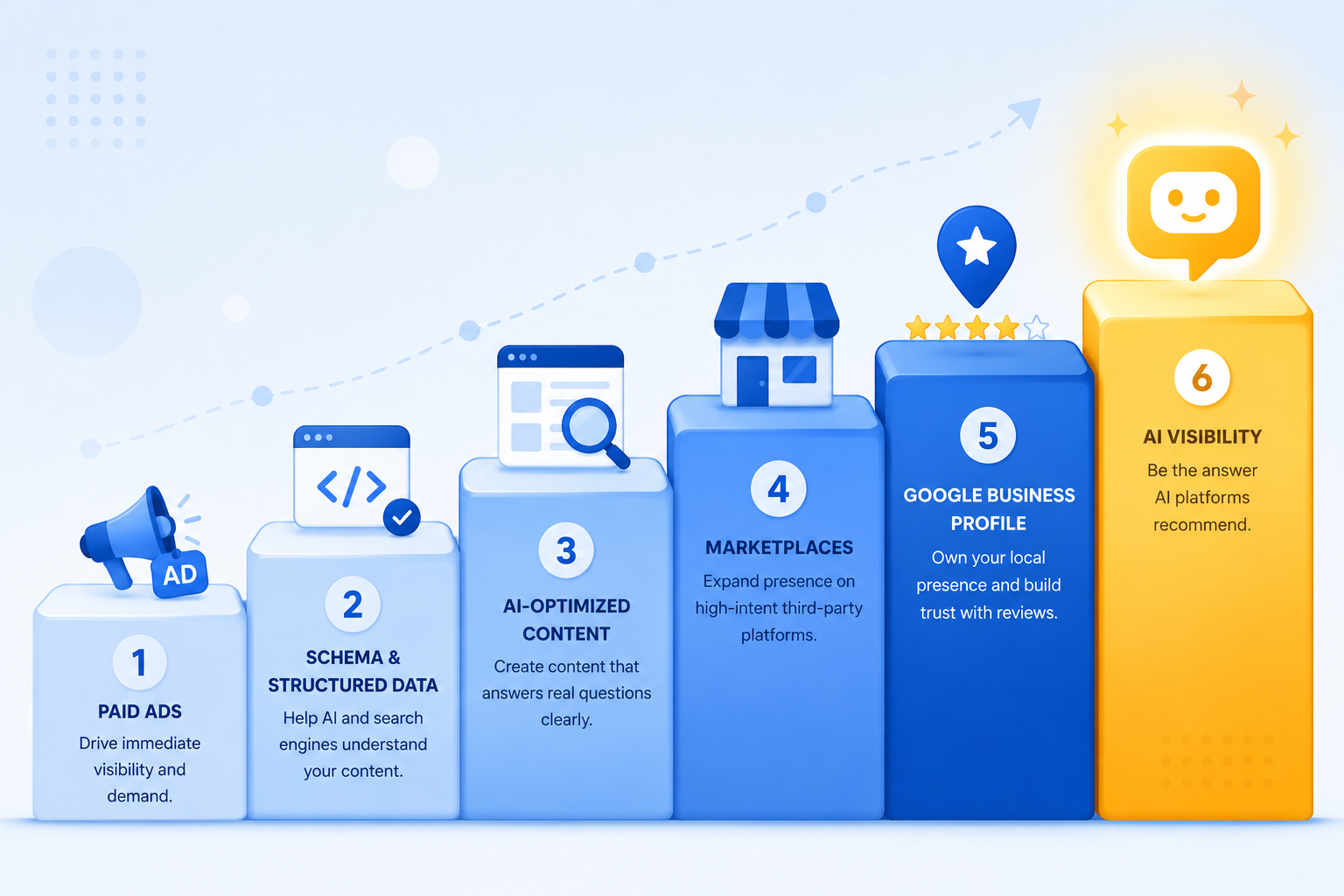
Dealers execute these 6 actions in priority order. Actions 1 and 2 address the direct replacement for the discontinued display. Actions 3 through 6 build multi-channel inventory visibility that reduces single-platform dependency.
1. Activate Google Vehicle Ads
Google Vehicle Ads (formerly Vehicle Listing Ads or VLAs) are the functional replacement for the discontinued free display. Google Vehicle Ads are an inventory-fed, paid ad format that displays a specific vehicle, including photo, price, mileage, dealer name, and availability, at the top of search results before the organic listings. Activation requires connecting a vehicle inventory data feed to Google Merchant Center, then linking Merchant Center to a Google Ads account with Vehicle Ads campaigns enabled. Google runs a Vehicle Feed Service Provider program approved by third-party partners that build and manage the feed for you and most dealership DMS/website platforms (CDK, Dealer.com, VinSolutions, and similar) can supply a Google-compatible inventory feed.
Performance benchmarks from AutoLeadPro’s 2026 automotive advertising analysis show that Vehicle Listing Ads generate 67% lower cost-per-click than standard text search ads, produce conversion rates between 8% and 20%, and drive approximately 268% more clicks for equivalent spend compared to standard search campaigns. These figures represent vendor-reported benchmarks from managed campaigns. Individual results vary based on feed quality, inventory pricing, and market competition.
2. Migrate VehicleListing Schema to Product or Vehicle Schema
Dealers with VehicleListing markup in their website code migrate to Product schema (or the Vehicle subtype within Schema.org’s structured data vocabulary). This migration keeps structured data valid and eligible for standard rich results in Search Console. The migration does not restore the discontinued GBP inventory display, that surface is gone. The migration ensures inventory pages remain eligible for standard product-type rich results and that Search Console shows clean structured data health.
Dealers without existing VehicleListing markup on their sites take no immediate action. Dealers using vehicle listing schema through a website vendor contact the vendor to confirm the migration timeline.
3. Build Inventory SEO on VDPs and Local Landing Pages
Vehicle detail pages (VDPs) and local inventory landing pages capture high-intent organic search queries. Organic search visibility is unaffected by the free listing discontinuation and the schema deprecation. Each local landing page should target a specific city-model-year combination with unique content, inventory counts, price range data, and dealer-specific trust signals.
Target query structures include:
- [year] [make] [model] for sale in [city]
- used [make] [model] [city]
- [make] dealership near [zip code]
- certified pre-owned [make] [city]
To fully capture this traffic, VDP optimization must include:
- Primary keyword in the page title tag (formatted as year-make-model-trim-city).
- Structured Product schema with accurate, real-time price and availability data.
- Unique meta descriptions written for every individual VDP.
- Strategic internal linking between related inventory pages to keep users on-site
4. Diversify Inventory Distribution Across Third-Party Marketplaces
Third-party automotive marketplaces capture buyers who begin searches outside Google. Dealers list inventory across 3 primary marketplace categories: dedicated automotive platforms, social commerce, and classified networks.
Dedicated automotive platforms: Cars.com, Autotrader, CarGurus, TrueCar, and Edmunds each carry distinct buyer audiences. CarGurus draws comparison-focused buyers, Edmunds captures research-first buyers, and Cars.com and Autotrader reach broader used-vehicle searchers.
Social commerce: Facebook Marketplace remains a high-traffic destination for used-vehicle shoppers. Facebook Marketplace listings are free for individual sellers and require a paid boosting investment for dealer-level reach.
Classified networks: Craigslist vehicles sections remain active for regional used-vehicle search, particularly among budget and local buyers. Dealers who maintained multi-marketplace distribution before the GBP listing discontinuation experienced the smallest visibility drop from the change.
5. Optimize Google Business Profile Engagement
The Google Business Profile itself remains active and is the first result most local buyers encounter when searching for a specific dealership by name. The discontinued feature was the free inventory display inside GBP, not GBP itself. GBP optimization priorities for dealerships in 2026 include: maintaining a complete and accurate Business Profile with current hours, service departments, and contact information; responding to all reviews within 48 hours; posting weekly inventory highlights or promotions using the GBP Posts feature; uploading current exterior and interior dealership photos at minimum monthly; and steadily growing review volume and average rating, both of which correlate with local-pack visibility.
GBP engagement metrics (review volume, review response rate, post frequency, and photo recency) correlate with local pack ranking position and influence the quality score of any Google Vehicle Ads campaigns running from the associated location.
The free interim play:
GBP Posts. While you stand up paid Vehicle Ads, you can keep some inventory visible in your Business Profile at no cost using the GBP Posts (Updates) feature. Post 10–15 of your strongest vehicles and short walk-around videos rather than your full inventory; think of it as parking your best cars out front. Dealers report these posts pulling hundreds of views within days. Refresh them as vehicles sell. It won’t replace the old automated inventory panel, but it’s the fastest free way to retain a vehicle presence during the transition.
6. Build AI Search Visibility (GEO)
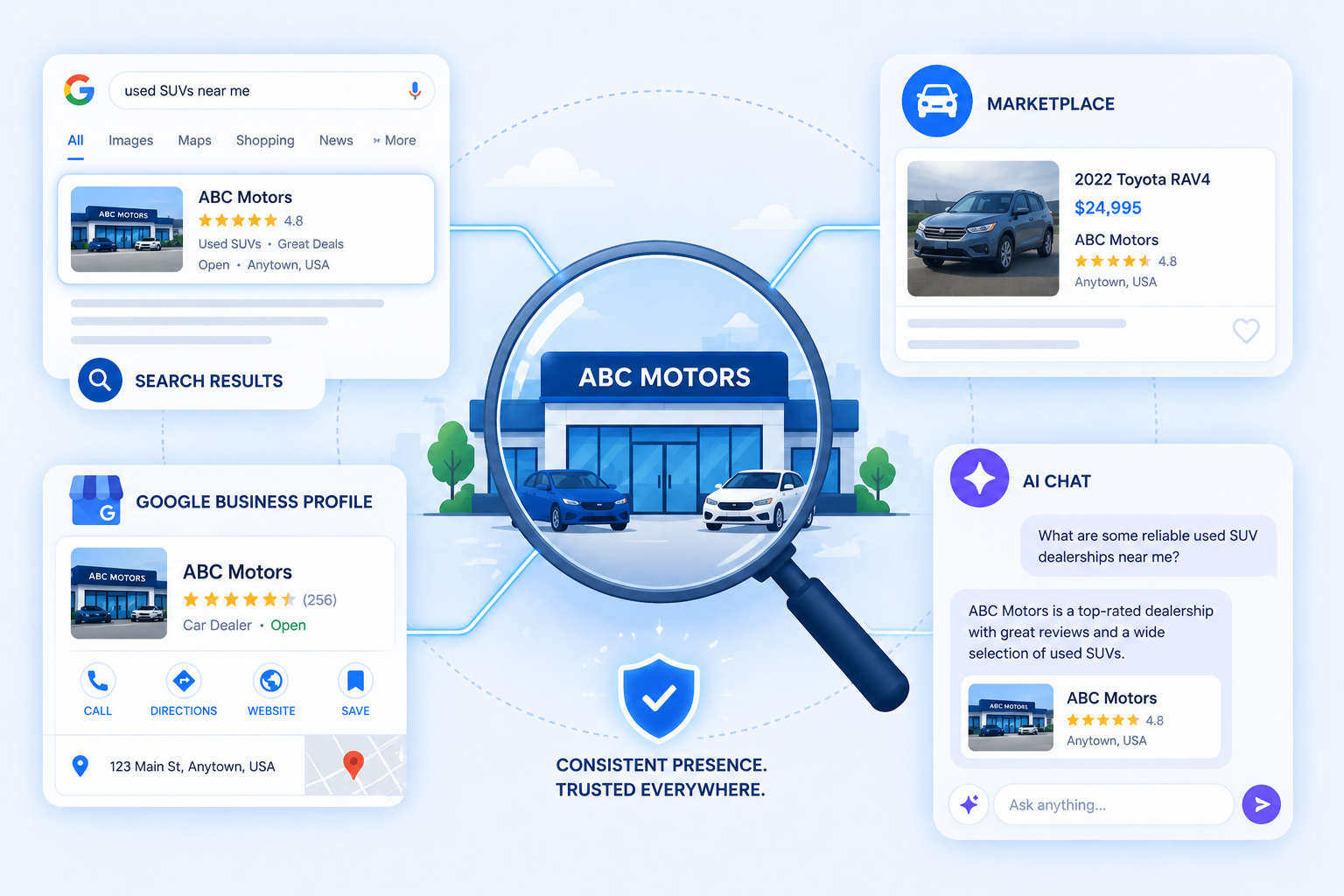
A measurable share of car buyers now begin vehicle research through AI-assisted search tools, including Google’s AI Overviews, ChatGPT, Perplexity, and Gemini, before reaching a dealership website. Dealer visibility in AI search responses requires structuring online content so AI models parse, cite, and surface dealership information accurately.
GEO (Generative Engine Optimization) actions for dealerships include: maintaining structured inventory feeds with complete schema markup, publishing locally authoritative content on vehicle categories and buying guides, earning citations from automotive trade press and local news sources, and ensuring NAP (name, address, phone) consistency across all platforms. Dealers absent from AI search responses during the vehicle research phase lose consideration before a buyer ever searches Google directly.
Don’t overlook Microsoft (Bing) Automotive Ads. Microsoft’s Automotive Ads place inventory in front of high-intent shoppers across Bing, MSN, Yahoo, and DuckDuckGo, and they accept vehicle types Google Vehicle Ads exclude, including motorcycles and RVs. For dealers, Bing carries a second advantage: it is the search index that feeds AI assistants like ChatGPT and Microsoft Copilot. Getting inventory and dealership data into Bing is therefore both a paid-acquisition channel and an AI-visibility channel one feed, two surfaces a Google-only fix won’t cover.
Vehicle Listing Ads vs. Free Listings: The Honest Trade
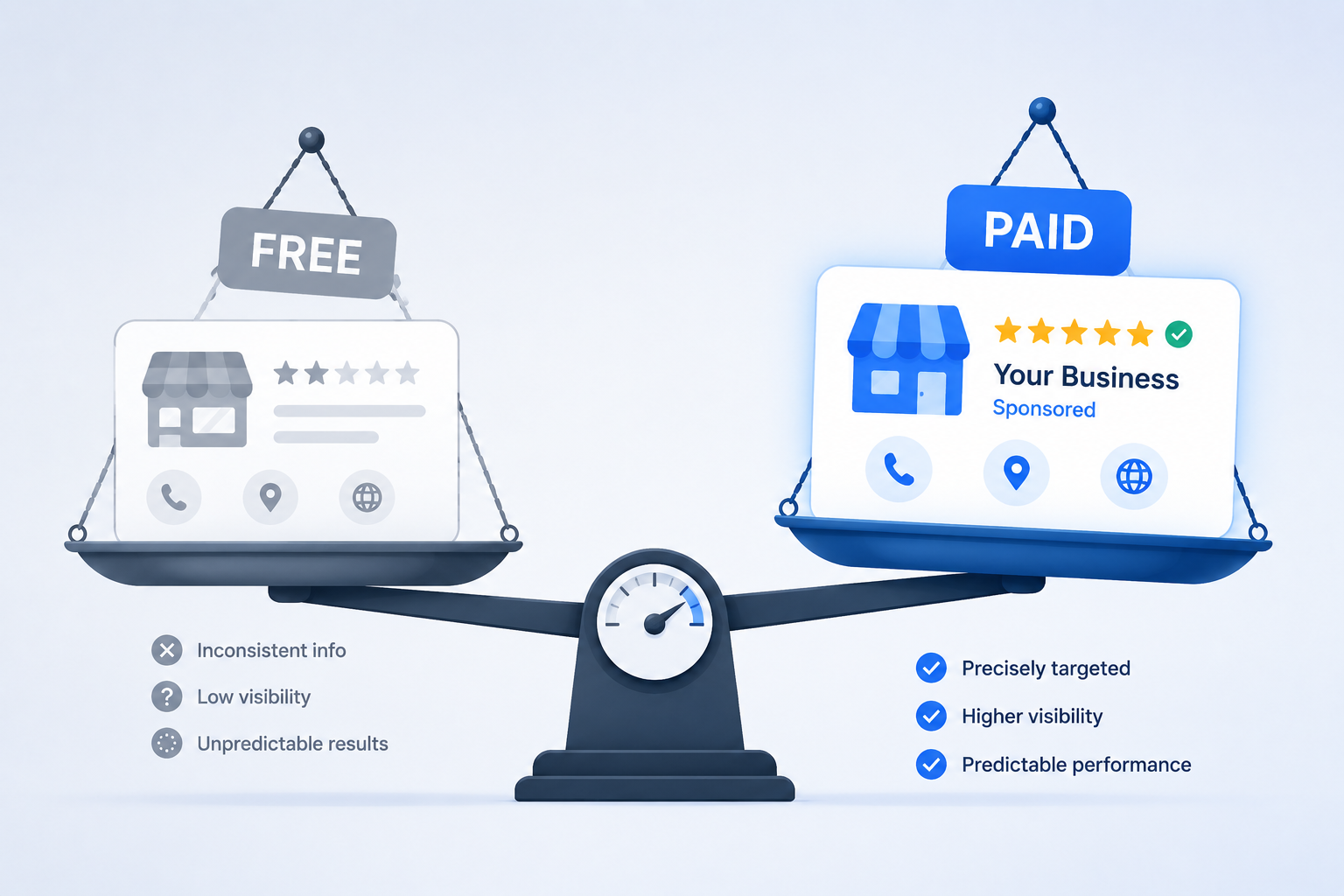
Google Vehicle Ads cost ad budget. The discontinued free listings cost nothing. The trade is paying for a more prominent, more accurate, and more measurable inventory display.
The discontinued free listings were limited by 3 structural constraints: inconsistent display based on feed-validation health, no guaranteed placement position, and no performance measurement outside basic impression data. Google Vehicle Ads place inventory above standard organic results with exact vehicle-level targeting. A buyer searching “2023 Toyota Camry SE under $28,000 near Houston TX” sees matching inventory from dealers running Vehicle Ads before reaching any organic result.
| Attribute | Free GBP Listings (Discontinued) | Google Vehicle Ads |
| Cost | $0 | CPC-based (cost per click) |
| Placement | GBP panel, visibility variable | Top of search results, above organic |
| Inventory accuracy | Feed-validation-dependent, prone to gaps | Direct feed-connected, real-time inventory |
| Performance data | Impression data only | Click, lead, call, and conversion tracking |
| Buyer targeting | Location-based only | Make, model, year, price, mileage, location |
| Feed requirement | Optional (markup path available) | Required |
Dealer profitability on Vehicle Ads depends on 3 variables: feed completeness and accuracy, competitive pricing relative to market, and campaign bid strategy. Dealers with clean inventory feeds, market-competitive pricing, and managed bidding consistently achieve cost-per-lead figures below standard search campaign benchmarks per AutoLeadPro’s 2026 analysis.
FAQs
Will Google vehicle listing removal cause ranking drops?
Google vehicle listing removal from Business Profiles does not cause organic ranking drops. The VehicleListing structured-data deprecation does not trigger Search Console errors or penalties. Dealer website pages ranking for inventory queries maintain those rankings independently of the GBP listing feature.
Does the old VehicleListing markup need to be removed from dealer websites?
Old VehicleListing markup does not require immediate removal. The markup becomes inert, it no longer produces the enhanced display and it no longer causes errors. Migrating to Product or Vehicle schema is the recommended action because it maintains structured data validity for standard rich results.
Is “Cars for Sale” on Google gone permanently?
The free “Cars for Sale” / “Vehicles for Sale” display inside Google Business Profiles is discontinued in late 2025. Google has not announced a free replacement program. Paid Google Vehicle Ads and feed-based inventory programs are the current path to inventory display at the top of Google search results.
How do dealers show car inventory on Google in 2026?
Dealers show car inventory on Google in 2026 through 3 channels: Google Vehicle Ads (paid, inventory-fed, appearing above organic results), optimized vehicle detail pages and local landing pages (organic SEO, no paid placement required), and complete Google Business Profile optimization (location panel visibility for branded searches).
What is the minimum requirement to run Google Vehicle Ads?
Running Google Vehicle Ads requires 3 components: a vehicle inventory data feed in Google’s required format, a Google Merchant Center account with the feed connected, and a Google Ads account with Vehicle Ads campaigns enabled. Feed creation is handled by dealership website vendors or third-party feed management providers.
Do small independent dealerships need Google Vehicle Ads?
Independent dealerships with inventory under 50 vehicles benefit from Google Vehicle Ads proportionally to their inventory volume and local search competition. Dealerships in markets with low Google Vehicle Ads competition achieve lower cost-per-click and higher visibility relative to high-volume franchise dealers. The fixed cost of feed setup is identical regardless of inventory size.
The Bottom Line on Google Vehicle Listings in 2026
Google discontinued free vehicle listings in Business Profiles in November 2025 (KGI Dealer Solutions reports November 12; Google issued no dated announcement). Google had deprecated the VehicleListing structured-data type earlier in 2025. Neither change eliminated inventory discoverability on Google, both changes removed the free, passive inventory display surface. Dealers who treat this as a signal to rebuild multi-channel inventory visibility come out of this change with a more durable position than they held before. Dependence on a single free Google feature was always a structural exposure.
The current path requires feed investment, paid placement through Google Vehicle Ads, organic VDP and local SEO, and active distribution across third-party marketplaces and AI search surfaces. Google vehicle listings through the Business Profile were a convenience, not a foundation. The dealers building on solid foundations, complete feeds, optimized inventory pages, multi-marketplace distribution, and AI-visible content, hold a position that no single Google product retirement can materially disrupt.
Not sure where your dealership shows up across Google, marketplaces, and AI search after this change? Get a free visibility audit and see exactly where buyers can find you, and where they can’t.
Sources reviewed June 2026. Google’s policies change, verify current status and exact dates before publishing.
- PureCars: Google Is Sunsetting Vehicle Listings (December 2025): confirms the Vehicles for Sale / Cars for Sale feature discontinuation.
- KGI Dealer Solutions: Google Is Ending Vehicle Listings (November 2025): reports the discontinuation of free GBP vehicle listings (November 12, 2025).
- Search Engine Land: Google drops reporting on several structured-data types (September 2025): VehicleListing among deprecated types; Search Console reporting removed.
- dbaPlatform: Is Vehicles for Sale Going Away? (June 2025): structured-data path vs. program distinction; feed-validation layer detail.
- DealerRefresh Forums: Dealers notice vehicle listings disappearing from Google Business Profiles (2025): practitioner reports of the phase-out; migration to Product schema confirmed.
- AutoLeadPro: Google Car Leads: 2026 Guide for Auto Dealers: Vehicle Ads performance benchmarks (CPC, conversion rate, clicks per spend).
- ALM Corp: Google Vehicle Ads Call Assets: 2026 Implementation Guide: Vehicle Ads infrastructure context; Call-Only Ads sunset timeline.
- Google Merchant Center Help, “Vehicle ads overview” / “Vehicle Feed Service Provider program” (supports the corrected feed-provider language): https://support.google.com/merchants/answer/11189169
- Search Engine Land, “Google rolling out cars for sale in Google Business Profiles” (Jan 2023; supports corrected launch timeline):
https://searchengineland.com/google-rolling-out-cars-for-sale-in-google-business-profiles-392234[1]