Skip to content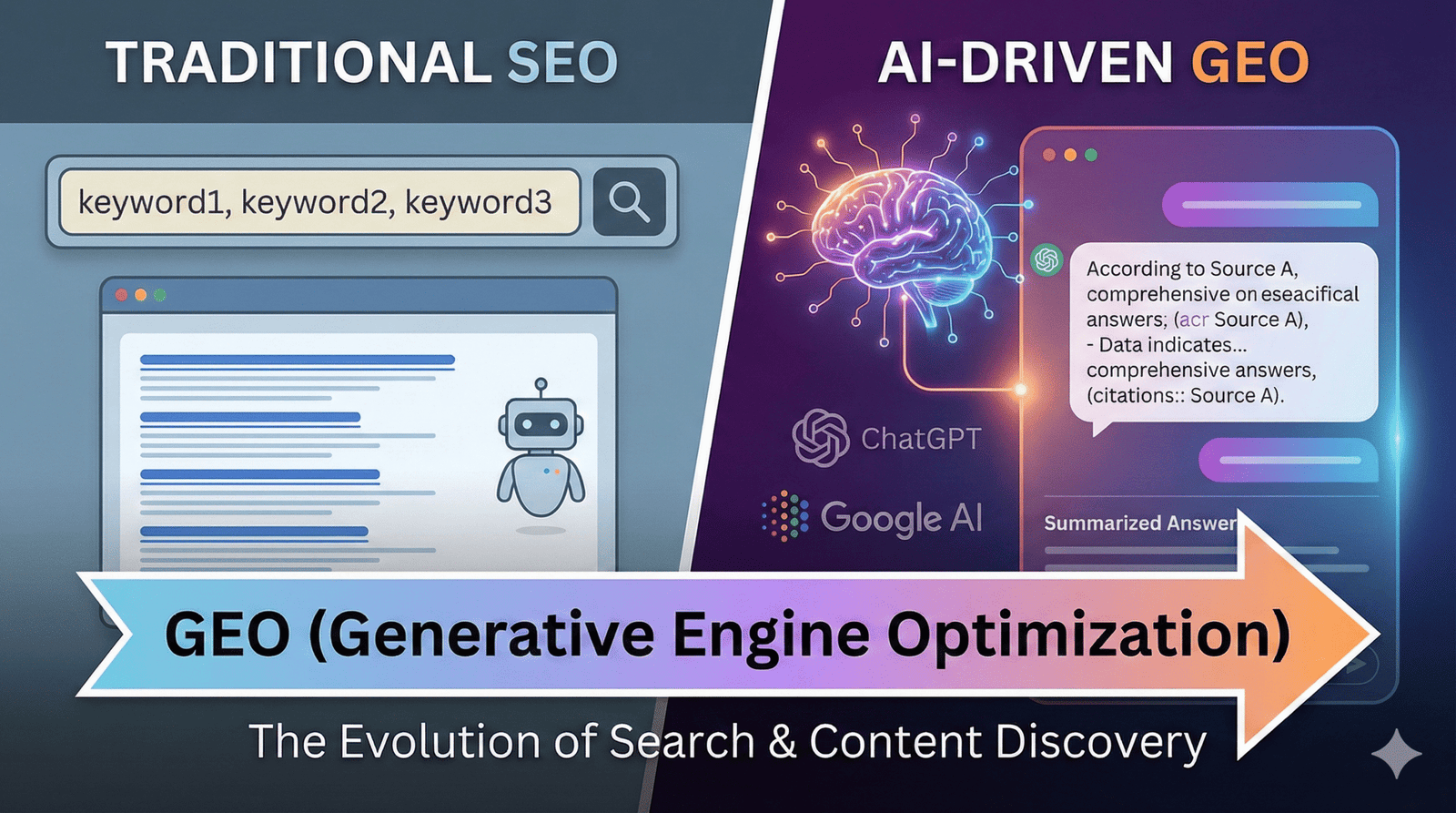
Princeton researchers tested 9 content optimization strategies to see which ones actually get content cited by generative AI engines like ChatGPT, Perplexity, and Google AI Overview. Three strategies delivered 30 to 40 percent higher visibility. One strategy, keyword stuffing performed 10 percent worse than the baseline. These are not opinions. This is peer-reviewed evidence. This is the practical guide to what makes content GEO-ready, how it differs from SEO content, and why growth-minded businesses that apply the winning patterns see demand generation results that generic advice cannot deliver. Our founding dealer partner cut aggregator dependency by approximately 20 percent inside 12 months using this framework.
Key Takeaways
- Princeton research tested 9 GEO content strategies. Three delivered 30 to 40 percent higher AI visibility: Cite Sources, Quotation Addition, and Statistics Addition.
- Keyword Stuffing performed 10 percent WORSE than baseline. Every SEO instinct that says “add the keyword more” is exactly wrong for GEO.
- Traffic from AI-cited content converts at 14.2 percent versus 2.8 percent for traditional Google traffic. Five times higher intent when the buyer arrives.
- Effectiveness varies by domain per the Princeton paper. Medspa, dealer, healthcare, and tech verticals each have different winning content patterns.
- The Answer Architecture™ framework operationalizes the Princeton framework at scale across every content asset, not one page at a time.
Understanding the New Search Landscape: What is GEO?
GEO (Generative Engine Optimization) is a formalized discipline introduced by Princeton and Georgia Tech researchers in November 2023 (Aggarwal et al., accepted to KDD 2024). It is defined as “the practice of optimizing content visibility in generative engine responses through a flexible black-box optimization framework.” Where SEO optimized for search engine rankings on a list of links, GEO optimizes for citation inside AI-generated answers.
AI search engines like ChatGPT, Perplexity, Gemini, and Google AI Overview synthesize responses from multiple sources rather than serving a ranked list. They interpret content for factual accuracy, entity clarity, and citation-worthiness then generate summarized answers where your content either gets cited as a source or gets skipped entirely. The rules for winning citations are different from the rules for winning rankings. This blog covers what actually works, backed by the research.
The 3 Content Patterns AI Engines Reward (And 1 That Backfires)
Every AI engine; ChatGPT, Perplexity, Gemini, Google AI Overview evaluates content the same way. Peer-reviewed research (Aggarwal et al., KDD 2024) tested nine content optimization strategies against generative engines. Three delivered clear wins. One made content perform measurably worse. This is what the research found.
Winner 1: Cite Sources
Explicitly mention the sources you draw from throughout your content. AI engines evaluate content credibility partly by whether it references verifiable sources. Content that cites external authorities gets 30 to 40 percent higher visibility in AI answers versus unattributed content. This is not about link-building. It is about giving AI engines specific, verifiable sources they can trust and reference when generating an answer.
Winner 2: Quotation Addition
Incorporate direct quotes from named experts, industry authorities, and research sources. Quotes give AI engines specific, attributable content to extract and cite. Same 30 to 40 percent visibility lift as source citation. The pattern that works: named expert plus specific claim plus context that shows why the claim matters.
Winner 3: Statistics Addition
Replace qualitative statements with specific quantitative data. Instead of “AI search is growing fast,” write “AI referral traffic grew 357 percent between June 2024 and June 2025.” Quantitative statements are extractable, verifiable, and citable. Same 30 to 40 percent visibility lift as the other two winners.
The Loser: Keyword Stuffing
Cramming target keywords throughout content performs 10 percent WORSE than the baseline unmodified content. Every SEO instinct that says “add the keyword more” is exactly wrong for GEO. AI engines look for signal quality, not signal density. Content full of keyword variations reads as low-quality to AI engines and gets deprioritized in citation selection.
The Princeton research also found that effectiveness varies by domain. Authoritative writing style wins for historical topics. Source citation wins for factual queries. Statistics addition wins for law and government. The general framework is right, but vertical-specific application is where the real gains live. Which brings us to the demand generation impact.
SEO vs GEO: The Evolution of Search Optimization
How AI-powered search is transforming content strategy
Traditional SEO
Keyword-Based Search
Primary Goal
High rankings in search results leading to link clicks
Optimization Focus
Keyword density and traditional ranking factors
Query Length
Average of 4 words per search query
Conversion Rate
2.8% average conversion from organic traffic
User Journey
Click link → Read content → Take action
Generative Engine Optimization (GEO)
AI-Powered Search
Primary Goal
Content cited directly in AI-generated answers
Optimization Focus
Clarity, structure, depth, and E-E-A-T authority
Query Length
Average of 23 words per conversational query
Conversion Rate
14.2% conversion (5x higher than traditional SEO)
User Journey
Direct answer → Immediate value → Higher intent action
The Verdict: GEO is an Evolution, Not a Replacement
Successful demand generation in 2025 requires both SEO fundamentals and GEO optimization to capture high-intent AI-driven traffic converting at 5x higher rates.
GEO vs SEO: An Evolution, Not a Replacement
While GEO represents a significant advancement, it builds upon the fundamental principles of traditional SEO. Both strategies aim to make content discoverable and valuable to users. They both emphasize user-first content, technical SEO fundamentals, and the crucial importance of E-E-A-T.
However, there are key differences in their primary goals and execution. SEO traditionally focuses on achieving high rankings in search results, leading users to click on a link to find information. GEO aims for content to be directly cited and used within the AI-generated answers themselves, providing direct value to the user within the AI interface.
Another divergence lies in optimization focus; SEO relies heavily on keyword density, while GEO prioritizes comprehensive structure, clarity, and authority. AI search queries are also significantly longer and more conversational, averaging 23 words compared to Google’s four-word standard. This indicates a shift from simple queries to complex questions.
Why GEO Content Drives 5x Higher-Converting Demand Generation
Traffic from AI-cited content converts at 14.2 percent. Traditional Google organic traffic converts at 2.8 percent. Five times higher conversion is not marginal. It changes what demand generation looks like. Buyers arrive from AI citations already convinced the AI already summarized your credibility, your data, and your differentiation before they clicked. Traditional demand gen metrics (impressions, clicks, MQLs) still exist but measure less of what actually moves revenue.
The metric that matters now is cost-per-citation. How much do you spend to get named by ChatGPT, Perplexity, Gemini, or Google AI Overview for the queries your buyers actually type? Every dollar tracked to a specific citation is a dollar tracked to a booked appointment or a demo request. Every dollar spent on content that never gets cited is a dollar tracked to nothing.
AI referral traffic grew 357 percent between June 2024 and June 2025 (1.13 billion visits). 25.7 percent of marketers are now creating AI-specific content. 38 percent of business decision-makers are budgeting for AI search optimization. The businesses winning demand gen in 2026 are the ones structuring content for AI citation, not just Google ranking.
Queries with eight or more words trigger AI Overviews 57% of the time, so marketers should focus on identifying these complex, multi-part questions and the underlying user intent behind them.
GEO also prioritizes content that is clear, in-depth, data-rich, and provides direct answers to build trust and authority with AI systems. Creating comprehensive resources that cover a topic exhaustively is crucial. Essentially, your content should position your brand as an expert and a reliable source.
Additionally, your content should be well-organized, using clear heading hierarchies (H1s, H2s, H3s) that help AI understand your main points. Paragraphs should also be short and digestible, enhancing scannability for both human readers and AI models. It’s best to write in a natural, direct, and answer-focused style as that aligns well with how AI search platforms operate.
The tactical content creation playbook copy-ready prompts, drafting workflows, refresh cadence, and specific patterns for medspa, dealer, healthcare, and tech verticals is covered in depth in our AI SEO Content guide.
See Where Your Business Is Invisible in AI Search
We run 20 buyer-intent prompts across ChatGPT, Perplexity, Gemini, and Google AI Overview for your business and your competitors. You see exactly where you rank, where they rank, and the gap to close. Free. Delivered in 24 hours. No credit card.
Carz4us: What Applying the Princeton 3 Winners Delivered in 12 Months
Our founding dealer partner was invisible in AI search when we started. Shoppers asking ChatGPT “best used SUV dealer near [city]” got recommendations. Our partner was not one of them. We restructured their VDP, SRP, city, and model pages using the Princeton 3 winners: every section cited sources (OEM specifications, Kelley Blue Book valuations, Carfax reports), incorporated named quotes from industry authorities and their own service team, and replaced qualitative claims with specific data (mileage, warranty terms, price comparisons, service intervals). We removed the keyword-stuffed patterns their prior agency had layered in — the exact pattern Princeton proved makes content perform 10 percent worse.
Inside 12 months, they cut aggregator dependency by approximately 20 percent while maintaining full sales volume. AI citation activity landed inside the first 90 days. The infrastructure now compounds every month. This is what the Princeton framework looks like when applied by an operator instead of theorized in a blog post.
The Answer Architecture™: Deploying the Princeton Framework at Scale
The Princeton research proves what content patterns work. Applying them consistently across every page, every service, every location, every treatment — that is where most businesses fail. Content that follows the framework on the homepage but ignores it on VDPs or treatment pages misses most of the citation opportunity.
The Answer Architecture™ is our proprietary 3-phase system for deploying the Princeton framework at scale. Phase 1 (Demand Intelligence) audits where you appear in AI answers today. Phase 2 (Full-Spectrum Presence) restructures every content asset using Cite Sources, Quotation Addition, and Statistics Addition. Phase 3 (Compound Growth) tracks cost-per-citation monthly and cuts what fails. That is the difference between reading about GEO and getting cited by AI.
FAQs
What is GEO-optimized content?
GEO-optimized content is content structured for AI engines to cite in their generated answers. Peer-reviewed Princeton research (KDD 2024) formalized the discipline. Where SEO optimizes content for search engine rankings on a list of links, GEO optimizes content for citation inside AI-generated responses from ChatGPT, Perplexity, Gemini, and Google AI Overview.
What are the 3 content patterns AI engines actually reward?
Princeton tested 9 optimization strategies empirically. Three delivered 30 to 40 percent higher AI visibility: Cite Sources (mention external sources explicitly), Quotation Addition (incorporate named expert quotes), and Statistics Addition (replace qualitative claims with quantitative data). These three work across every AI engine because AI engines evaluate content credibility on verifiable signal, not keyword density.
Why does keyword stuffing hurt GEO content?
Princeton’s empirical research found Keyword Stuffing performed 10 percent WORSE than the baseline unmodified content. AI engines look for signal quality, not signal density. Content full of keyword variations reads as low-quality and gets deprioritized in citation selection. Every SEO instinct that says “add the keyword more” is exactly wrong for GEO.
How is GEO content different from SEO content?
SEO content is optimized to rank on a list of links. GEO content is optimized to be cited inside the AI answer itself. The overlap is real (both value clarity, structure, and E-E-A-T) but GEO adds structural requirements SEO does not enforce: direct-answer openers, self-contained passages, entity signals, cited sources, named quotations, and quantitative data. Content that satisfies both is content that ranks and gets cited.
How do I audit my existing content for GEO readiness?
Score every page against the Princeton 3 winners. Does every section cite specific sources? Does the content include named quotes with attribution? Does it replace qualitative statements with quantitative data? Then check for the loser: is the content keyword-stuffed with variations of the target phrase? A page that scores 3 out of 3 on the winners plus 0 on the loser is GEO-ready. Anything less needs restructuring.
Do different verticals need different GEO content patterns?
Yes. Princeton found effectiveness varies by domain. Authoritative writing style wins for historical topics. Source citation wins for factual queries. Statistics addition wins for law and government. Applied to our verticals: medspas benefit most from statistics on treatment outcomes and clinical citations. Dealers benefit most from source citation (OEM specs, Kelley Blue Book) and quotation from service authorities. Healthcare benefits most from statistics plus credentialed medical author quotation. Tech benefits most from statistics plus expert quotation.
How is DemandNow different from a generic content agency on GEO?
Generic content agencies recite the Princeton research and offer content packages. We are operators. Our founding dealer partner applied this framework and cut aggregator dependency by approximately 20 percent inside 12 months while maintaining full sales volume. The Answer Architecture™ is our proprietary system for deploying the Princeton framework at scale across every content asset, tracked monthly against cost-per-citation. That is the operator standard we hold ourselves to.