Skip to content
A lot has been changing in online searches, with generative engines powered by artificial intelligence (AI) reshaping how buyers find information. For growth-minded businesses looking to maintain visibility and capture market share, generative engine optimization (GEO) is an important strategy in ensuring their brand sits front and center of buyer discovery.
Key Takeaways
- Distinct from traditional SEO (search engine optimization), GEO focuses on content citation within AI summaries.
- AI-driven search is transforming buyer journeys, reducing traditional clicks.
- Successful GEO strategies prioritize content authority, structured data, and natural language.
- Optimizing for prompt-based queries and semantic meaning is crucial for content that gets cited.
- Growth-minded businesses must create highly credible, intent-based content to be cited by AI.
- Measuring GEO success involves tracking AI citations and brand mentions, not just website traffic.
What is Generative Engine Optimization?
Generative engine optimization is the process of optimizing digital content to rank prominently and be cited accurately by AI-powered generative search engines. Unlike traditional SEO, which targets organic rankings on search engine results pages, GEO aims for your content to appear within the AI’s summarized answers or AI Overviews. This is a critical evolution for modern marketing, as buyers increasingly rely on AI for initial research and solution discovery.
GEO ensures that when a buyer asks an AI chatbot a question, your company’s insights or solutions are among the authoritative sources referenced. It shifts the focus from securing a top search result link to becoming a trusted source within the AI’s direct response. This adaptation is essential for brands to be found by decision-makers exploring solutions through AI.
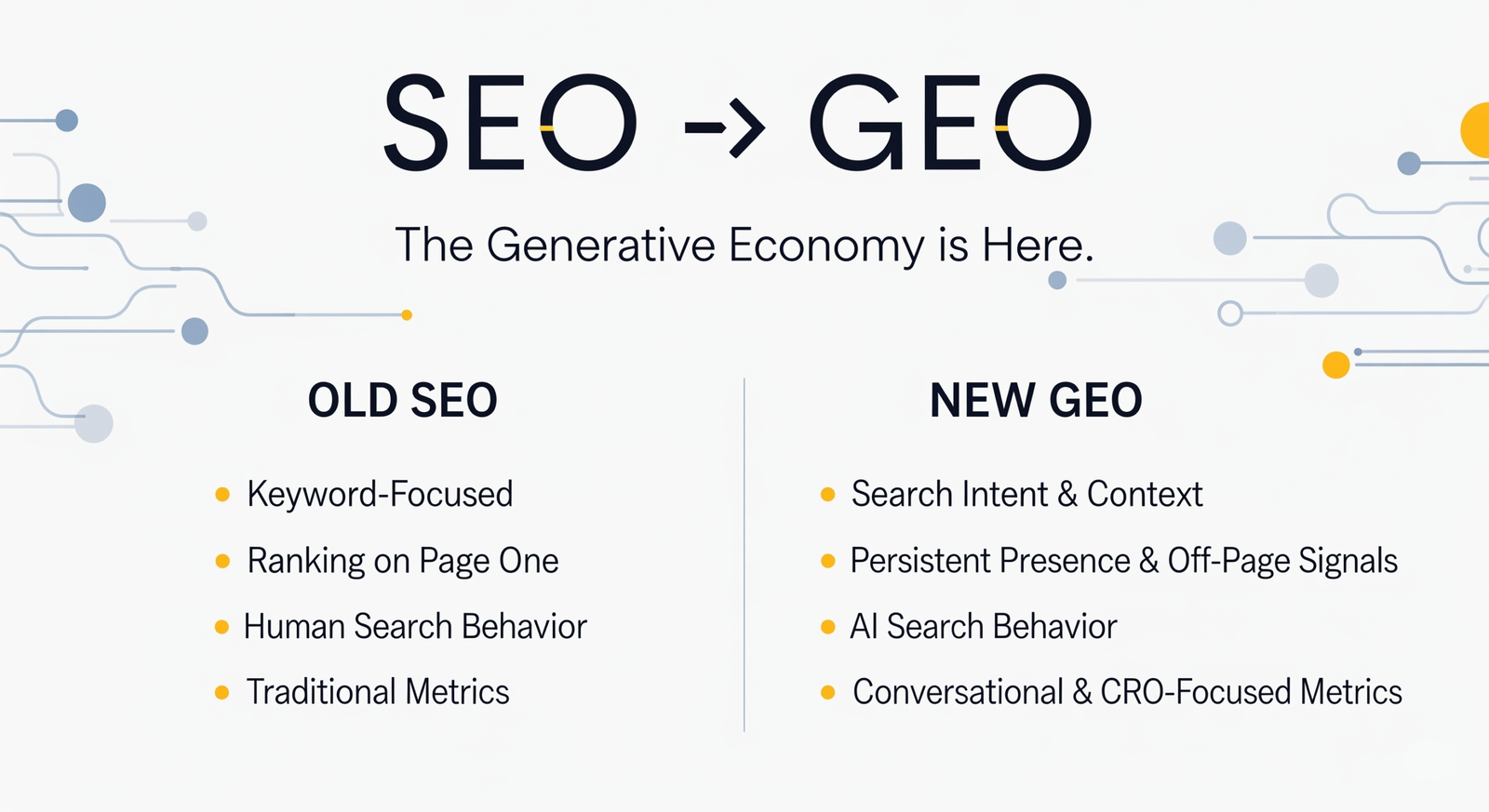
GEO vs SEO: Understanding the Fundamental Differences
While traditional SEO and GEO share common goals of visibility, their methodologies and targets differ significantly, Recognizing these distinctions is key for marketing strategists.
Keyword vs Semantic Search
Traditional SEO often focuses on exact keyword matching and variations to rank for specific queries. GEO, however, centers on semantic search, understanding the underlying meaning and intent behind a user’s prompt. AI models prioritize content that comprehensively answers a complex question, not just content with specific keywords.
How Search Behavior Changes with Generative AI
Traditional search is largely transactional, driving users to click on links. With generative AI, search behavior becomes more conversational and prompt-based. Buyers can ask nuanced questions and expect direct, synthesized answers, often eliminating the need to click through to multiple websites.
How Generative Search Engines Display Content
Traditional search engines display a list of hyperlinks, aiming for users to click to a website. Generative search engines, conversely, provide summarized answers, direct responses, or AI Overviews. Visibility in AI-generated answers requires different content optimization from traditional SEO, as businesses now compete to be cited in the AI’s answer, rather than just ranking on the first page of the search results.
What SEO Strategies Still Matter in GEO
While GEO represents a shift, foundational SEO strategies remain vital. E-E-A-T (experience, expertise, authoritativeness, trustworthiness) is still paramount. High-quality, well-structured content that is accurate and credible will always be preferred by both human users and AI models.
Why Generative Engine Optimization is Essential for Growth
The rise of AI-driven search is fundamentally transforming the buyer journey, making GEO a non-negotiable strategy for growth. Ignoring this shift risks significant market invisibility.
The Rise of AI-Driven Search and its Impact on Buyer Journeys
AI chatbots are poised to significantly reduce traditional search engine queries. By 2026, Gartner predicts AI chatbots will reduce traditional search engine queries by 25%, directly affecting how and where businesses get discovered. This trend is already underway, with 71% of Americans using AI to search for information online in 2025. This shift means buyers are increasingly consulting AI tools for their initial research into solutions. The impact is clear: 60% of Google searches now end without clicks, as users increasingly find answers directly from AI-generated responses.
New Discovery Channels and Market Share Opportunities
As AI platforms become new search entry points, they present new discovery channels for growth-minded brands. AI platforms currently drive 6.5% of organic site traffic and are projected to rise to 14.5%. This growth signals a significant opportunity to capture market share through optimized content. Businesses that adapt early to GEO will gain a distinct competitive advantage.
How AI Systems Choose What to Cite
Understanding why AI engines pick some pages and skip others helps make sense of every tactic in this guide. Most conversational AI systems follow a three-step process when a user asks a question.
Query rewriting : The AI does not take the user’s query word for word. It rewrites or expands the original query into related search formulations to better capture intent.
Retrieval : The engine issues one or more search requests to indexes or the live web. Gemini leans on Google’s infrastructure; Perplexity performs live retrieval across multiple sources. Which engine your buyer uses affects what results they see.
Citation selection : The engine sifts through the top-ranking pages and picks the passages that appear most relevant and trustworthy, then synthesizes them into an answer.
Two signals repeatedly show up as citation determinants across studies: front-loaded value (where the most useful information sits at the beginning of the document) and cross-web consensus (the same claim showing up on multiple authoritative sources). Both are levers you can pull in the tactics that follow.
7 Core Components of a Successful GEO Strategy
Implementing a robust GEO strategy requires a multi-faceted approach, focusing on how AI models process and prefer content. Here are seven critical components.
For a deeper look at the content-layer writing patterns that drive AI citation, see our companion guide: GEO-Optimized Content and How AI Search Is Changing Demand Generation
Writing for Intent, Not Just Keywords
Understanding the buyer’s intent is important. AI excels at interpreting nuanced queries. Your content should directly address various intents, whether it’s an informational query like “what is a CRM for sales,” a commercial investigation such as “best project management software for engineering teams,” or a transactional query like “CRM integration services,” referring to customer relationship management.
Using Multiple Synonymous Phrases Naturally
AI models are sophisticated in understanding contextual relevance and synonyms. Instead of keyword stuffing, incorporate a natural diversity of related terms and phrases. This ensures your content can be connected to a broader range of queries, even if the exact phrasing isn’t used by the searcher.
Structuring Content Effectively
Clear and logical content structure is crucial for AI comprehension. Use concise headings (H2s and H3s), short paragraphs, bullet points, and numbered lists to break down complex topics. This makes information easy for AI to parse and synthesize, leading to higher chances of citation.
Where you place your best information matters as much as the information itself. One study of AI citation patterns found that 44.2% of ChatGPT citations come from the first 30% of a document. Lead with the direct answer, then support it with the evidence and context beneath.
Content Authority and Credibility
E-E-A-T is amplified in the AI era. This means leveraging industry experts, citing reputable research, and backing claims with data. GEO interventions like improved citation, adding statistics, and direct quotations can boost visibility for lower-ranked websites by up to 37% in generative responses. GEO methods notably boost source visibility by over 40% across various queries when including citations, quotations, and statistics.
Understanding Prompt-Based Search Behavior
Buyers use conversational prompts to ask AI complex questions. Your content should be written in a direct, conversational tone that anticipates these types of queries. Provide clear, concise answers to potential “how-to,” “what is,” and “best practices” questions relevant to your industry.
Leveraging AI-Generated Snippets and Summaries
Optimize your content to provide concise, direct answers that AI can easily extract for snippets and summaries. This includes clearly defining terms, offering quick solutions to common problems, and presenting key information upfront. This increases the likelihood of your content being chosen as the source for an AI-generated answer.
Incorporating Structured Data
Schema markup helps AI models understand the context and purpose of your content. Implement relevant schema types like Organization, Product, Service, FAQ, or HowTo markup. This provides explicit signals to AI about your content’s nature and relevance to buyer queries, enhancing discoverability.
Unlinked Brand Mentions and Cross-Web Signals
AI systems appear to weight brand mentions across the web even when those mentions are not linked. That is a shift from traditional SEO, where the link is the signal. In the AI era, the mention itself carries weight.
Three practical implications:
Wikipedia presence matters. Wikipedia makes up a significant portion of training data for large language models. An accurate Wikipedia entry for your brand may increase the likelihood of being mentioned in AI responses.
User-generated content platforms show high AI exposure. Reddit, YouTube, Quora, and similar UGC platforms are indexed heavily by generative engines. Consistent brand presence and helpful contributions on these platforms show up in AI responses more often than in traditional search results.
Digital PR earns its keep in a new way. Third-party mentions from reputable news and industry publications now function as cross-web consensus signals for AI, not just backlink signals for Google. Both matter, but the calculation of ROI on PR has changed.
Actionable Tips: Implementing GEO for Your Business
Transitioning from theoretical understanding to practical implementation is key for GEO success. These actionable tips will guide your efforts.
Comprehensive Topic Research
Start by thoroughly researching your customer’s queries and pain points. Use tools to analyze competitor content that is already being cited by AI. Understand the language your target audience uses when researching solutions to their business challenges.
Creating Query-Intent Based Content at Scale
Focus on producing high-quality, comprehensive content designed to answer specific buyer queries. Comparative listicles are highly effective, with 32.5% of all sources cited by large language models (LLMs) being comparative listicles. Develop in-depth guides, case studies, and solution-focused articles that address customer problems from multiple angles.
Implementing Digital PR Activities
Increase your brand’s authority by engaging in digital public relations. Seek expert quotes, participate in industry podcasts, and secure media mentions. These activities build domain authority and signal to AI that your brand is a trusted voice in your sector.
Embracing Multimedia for AI Comprehension
While text is primary, incorporating relevant multimedia assets can enhance content comprehension for AI. Use infographics, explainer videos, and well-labeled images that complement your textual content. This enriches the overall content experience and provides diverse data points for AI processing.
Strategic Content Distribution
Distribute your content strategically across various platforms. Community channels like Reddit and Quora are crucial as LLMs train on content from these platforms. Share on LinkedIn, industry forums, and other relevant social platforms to broaden reach and signal topical relevance to AI.
Optimizing Your Website’s AI-Readiness
Regularly audit your website for AI readiness. This involves technical SEO best practices, site speed, mobile-friendliness, and ensuring content is easily crawlable. Continuously monitor how AI generative engines are citing your content and adjust your strategy accordingly.
One technical gotcha worth flagging: AI crawlers often struggle with JavaScript-heavy pages. If your content relies on client-side rendering, AI engines may not see it at all. Server-side rendering (SSR) or static site generation makes your content visible to both traditional search crawlers and AI retrieval systems.
The Answer-First Page Layout
AI engines favor pages where the answer sits at the top. This is not a new principle in content design, but it becomes more important in a citation economy where AI is scanning for extractable answers rather than reading full articles.
A reliable four-part structure:
- Header formatted as the high-intent question your buyer asks.
- A short, factual answer in one or two sentences directly beneath the header.
- Supporting evidence in the next paragraph: data, statistics, expert quotes, source citations.
- The comprehensive narrative that contextualizes the answer for readers who want depth.
The point of this structure is not to shorten your content. It is to give AI a clean passage to extract while giving the human reader a full explanation if they scroll. Pages formatted this way have shown 30 to 40 percent improvements in generative engine citation rates in analyses of AI response patterns.
Measuring Success in the Generative Era
Measuring GEO performance presents new challenges compared to traditional SEO, requiring a shift in what marketers monitor.
Challenges in Tracking GEO Performance
Directly tracking AI citations can be complex, as generative AI platforms don’t always provide detailed attribution analytics. Unlike traditional organic search traffic, where Google Analytics provides clear data, AI-generated answers might not always drive direct clicks to your site.
What to Monitor
Instead of solely focusing on website clicks, marketers should monitor:
- AI citations: How often your brand or specific content is cited in AI-generated answers.
- Brand mentions: Track mentions across the web, especially those that appear in AI summaries.
- Traffic from AI-driven sources: While indirect, look for increases in branded search queries or direct traffic that might originate from AI research.
- Engagement metrics: Monitor on-page engagement if users do click through, indicating content quality.
Tools and Approaches for Assessment
While specialized GEO tools are still emerging, teams can leverage existing resources. Use brand monitoring tools to track citations. Analyze search console data for non-click search impressions where your content might be providing direct answers. Conduct manual spot-checks by prompting AI models with relevant queries and observing which sources are cited.
Adapting to the Future of AI Search
Generative engine optimization is fundamentally reshaping how businesses achieve visibility and connect with their target audience. By understanding the nuances of AI-driven search, prioritizing content authority, and adopting new optimization strategies, marketers can secure their brand’s position as a trusted source. Embrace GEO to ensure your solutions are discovered by the next generation of decision-makers.
FAQs
What is the main difference between SEO and GEO?
The main difference is that SEO aims for organic search rankings to drive clicks, while GEO optimizes content to be directly cited and summarized by AI generative engines. GEO focuses on being a source within AI’s answers rather than just a top link.
Why is GEO becoming crucial for growth-minded businesses?
GEO is crucial because AI chatbots are predicted to reduce traditional search queries significantly, and a high percentage of online searches now end without clicks. Buyers are increasingly using AI for initial research, making GEO essential for brand visibility.
How can businesses improve their content for GEO?
Businesses can improve content for GEO by focusing on clear structure, comprehensive answers, natural language, and high authority. Incorporate citations, statistics, expert insights, and relevant schema markup to enhance AI comprehension and citation potential.
What types of content are preferred by generative AI?
Generative AI often prefers well-structured, comparative listicles, comprehensive guides, and content that directly answers specific questions. Content with strong E-E-A-T signals is highly favored for citation.
How do you measure the success of GEO?
Measuring GEO success involves tracking AI citations of your brand or content, monitoring brand mentions in AI-generated summaries, and observing increases in branded search queries. Direct website traffic is still a factor, but the emphasis shifts to AI visibility.