 Skip to content
Car shoppers spend much of their research time on sites you don’t own. In Cox Automotive’s latest Car Buyer Journey study, 75% of buyers visited third-party websites while shopping, more than any other type of site, and buyers visited 4.6 sites on average. Many of those marketplaces rank for your models in your city.
As part of your owned channel playbook, dealership landing pages help you win those searches back.
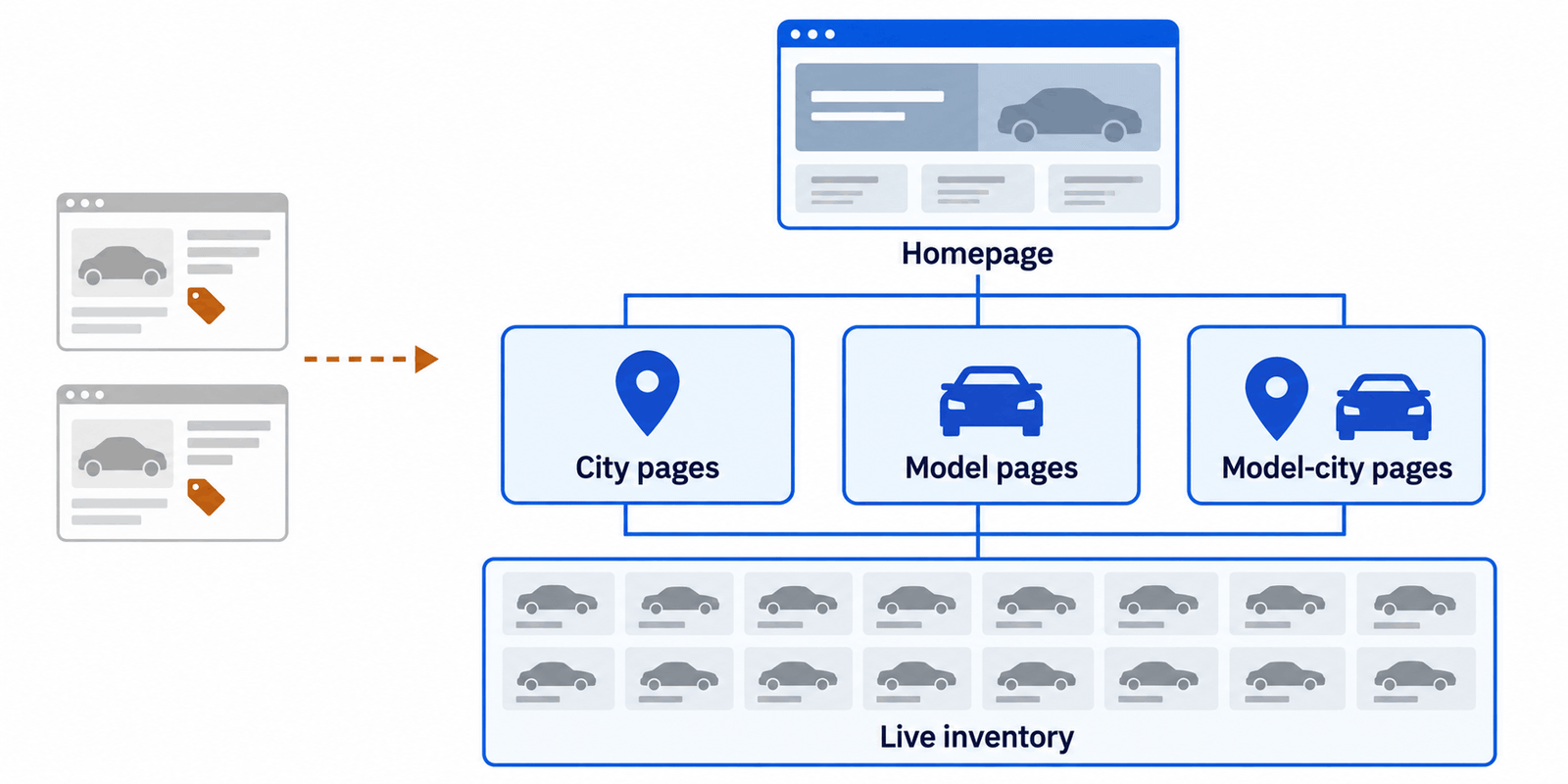
The strongest setup uses three page types working as one system. City pages, model pages, and model-city pages, linked together, cover the way people actually search and give each query a real answer.
This guide lays out that architecture, the discipline that keeps it clean, and the build order.
Which Search Terms Should Your Dealership Target?
Non-brand demand shows up in a few recognizable shapes. Learn them and the page plan writes itself.
- The first is the dealer search, written as [city] [make] dealer. Think “Paterson Honda dealer.” The person wants a nearby store that carries a brand. Intent is high and local.
- The second is the model search, written as [model] for sale [city]. Think “Honda Civic for sale Paterson.” The person has a model in mind and wants local inventory and a price. This is the largest share of non-brand demand for most stores, because shoppers search the model far more than the store.
- The third is the comparison search, written as [model] vs [model]. For example, “Civic vs Corolla.” The person is still choosing and reads before they visit.
Near-me searches can appear in all three types. And because 71% of buyers in Cox Automotive’s latest study started shopping unsure which vehicle they would buy, a model search is often a shortlist decision you can still win.
Each search type needs a different page. Build the right page for each search, and you can reach shoppers at different stages of the buying process.
What Dealership Landing Pages to Build
A dealership website needs more than a homepage and inventory pages. Each search type needs a page built around what shoppers are actually looking for, so these pages need to be useful, specific, and relevant to the search.
The three main page types are city pages, model pages, and model-city pages. Here is what each one does and what to include.
City pages
Local market pages
Model pages
Per model line
Model-city pages
Where volume justifies
VDPs / SRPs
Live inventory pages
Google Business Profile
Store profile & reviews
City Pages
Build one city page for each market you genuinely serve. A market you serve means a place with real customers, real drive time, and something true to say. Skip the towns where you have no presence.
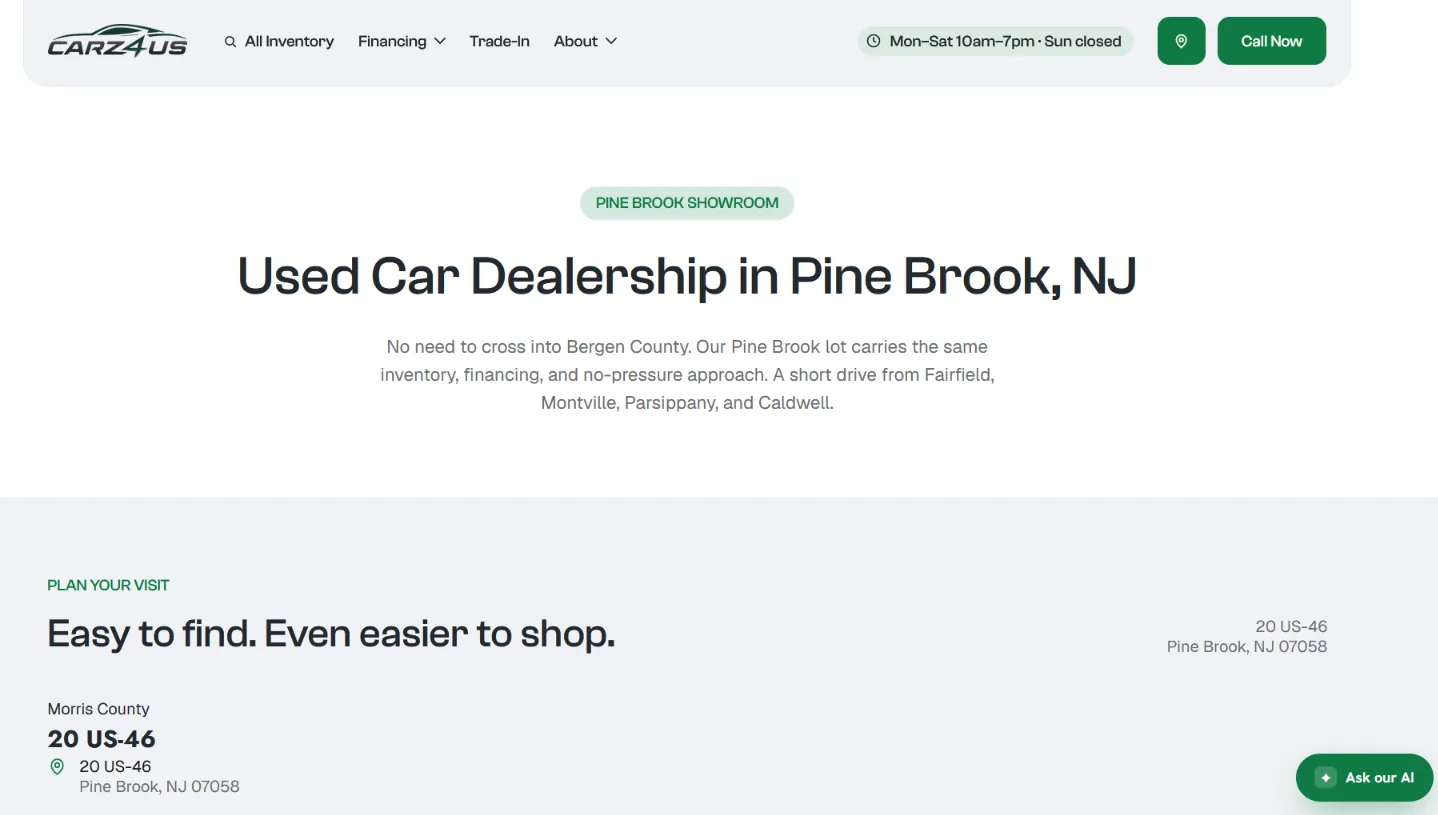
A city page earns its spot when it carries local substance that no template can fake. Give each one these elements.
- Live inventory: Show current inventory for that market, pulled from your inventory feed. Never hard-code numbers that can quickly become outdated.
- Directions and drive times: Show how long it takes to reach the dealership from nearby areas, with a map.
- Local staff: Name the sales and service staff who actually work at that store, with photos.
- Financing and trade-ins: Explain store-specific financing and trade-in options in plain language.
- Local reviews and service information: Show reviews and explain what shoppers can expect when they visit.
- Location-specific FAQs: Answer practical questions about hours, languages spoken, same-day availability, and other local concerns.
Many vendor-built location pages are just the same template with a different city name. Those pages give shoppers little reason to choose them. A useful city page should feel like a real dealership serving a real local market.
A multi-rooftop used-car dealer group we’ve worked with describes exactly this problem with their previous location pages: the vendor template repeated across stores with only the city name swapped, and none of them ranking. It’s a common complaint from operators running more than one location, and it’s the clearest argument for building pages with real local substance instead of a shared template.
Model Pages
Build one model page for each model line you carry, such as a Civic or CR-V page. Think of it as the page that answers the questions shoppers usually ask a salesperson.
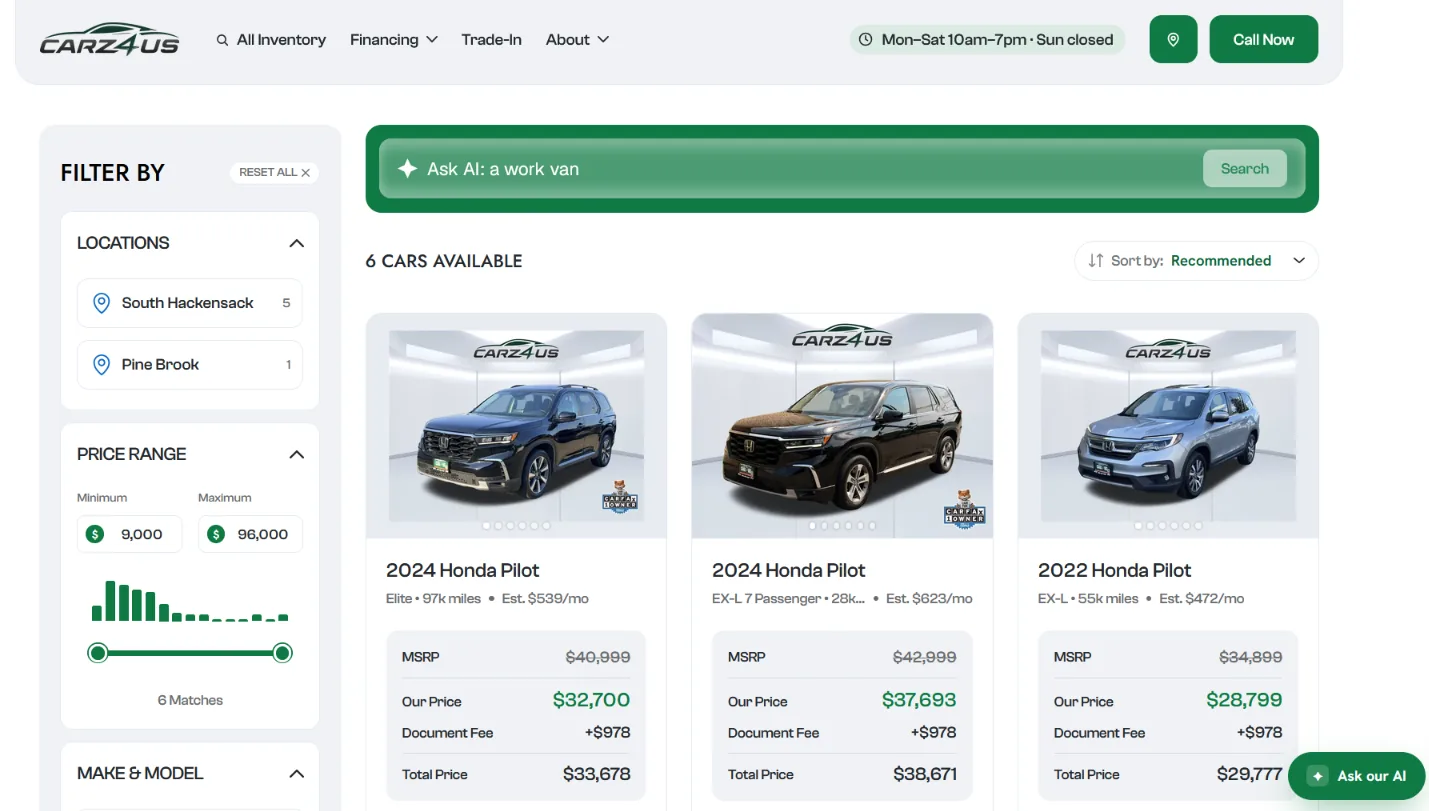
Here’s what to include:
- Current pricing: Show the real price range for the model on your lot and explain what affects the price.
- Live inventory: Show the units you currently have, including trims and mileage.
- Trim differences: Explain what shoppers get with each trim in plain language.
- Model comparisons: Compare the model with common alternatives, since many shoppers are still deciding what to buy.
- Financing and trade-ins: Give shoppers clear information about your financing and trade-in options.
- Model-year details: Keep different model years clear so, for example, a 2024 Civic and a 2026 Civic don’t compete for the same page or confuse shoppers.
You don’t need to force in every detail. If something doesn’t make any sense for that model, leave it.
Cox Automotive found a gap between what buyers want to do online and what they end up doing. In its latest study, 48% wanted to apply for credit online, but only 33% did. And 37% wanted to finalize the price online, while only 19% did.
A strong model page can close some of those gaps. Give shoppers clear pricing, financing information, inventory, and trim details before they contact the dealership to build trust.
Model-City Pages
The third page type targets searches like [model] for sale [city], such as “Civic for sale Paterson.”
These pages combine a specific model with a specific market, so you should build fewer of them. Focus on your top models in your top markets, where search demand justifies a dedicated page. Check Search Console for queries that already pair the model with the city, and build a model-city page only where those queries show up. A handful of useful pages beats hundreds of thin ones.
Each model-city page should include information specific to both the model and the location. Include these.
- Live inventory: Show how many units of that model are available at that store right now.
- Local buying details: Explain pickup, test drives, delivery, and other store logistics.
- Local pricing: Show the all-in price, including mandatory dealer fees such as the document fee, as the most prominent figure, plus any buying details specific to that market. [COMPLIANCE]
- Relevant comparisons: Compare the model with another vehicle that shoppers commonly cross-shop in that market.
- Unique local information: Give shoppers a reason to visit this page beyond seeing the city name in the title.
If the page is just your model page with “Paterson” added, you don’t need a separate URL. Keeping that standard high prevents your site from filling up with hundreds of near-identical pages.
Are Dealership City Pages Doorway Pages?
Short answer: they can be. Google’s spam policies list pages targeted at specific regions or cities that funnel users to one page as an example of doorway abuse.
That means a city page with nothing more than a changed city name is a problem. A page with real local information is much more useful to both shoppers and search engines.
Every page in this system has to pass one question.
If you swapped in a different city’s name, would every sentence on the page still be true?
If the answer is yes, the page has nothing local to offer. It is a doorway and needs to change or go.
That matters for shoppers, too. In Cox Automotive’s latest study, 66% of buyers considered both new and used vehicles. The pages that help them build a shortlist need to give them a real reason to consider your dealership.
Accuracy matters as well. The FTC’s September 2026 pricing FAQs say the advertised price must be the actual price any consumer can pay, including dealer-required fees, which makes accurate, store-specific information even more important.
Same page, town swapped
Paterson Honda Dealer
Clifton Honda Dealer
Wayne Honda Dealer
Only the town name changes. Nothing else is true or useful on its own.
One real local page
South Hackensack Honda
142 vehicles in stock, updated today
Route 17, 8 min from Hackensack
James, Rosa, and Dan, with photos
4.8 from 312 local reviews
Remove the city name and the page still stands on its own.
How to Link Dealership Landing Pages Together
These pages should work as one system. The goal is to help shoppers move from a broad search to a specific vehicle while passing authority through your site.
| From | Links to | Why |
|---|---|---|
| City page | Model pages, model-city pages, Google Business Profile | Moves broad local searches toward a model |
| Model page | City pages, model-city pages | Connects a model to the markets you serve |
| Model-city page | Search results, vehicle detail pages | Gives ready-to-buy shoppers a path to inventory |
Anchor text should describe where the link goes. Vary it naturally instead of repeating the same keyword on every page. For the profile itself, see how to set up a dealership Google Business Profile.
The buyer journey goes like:
Broad search → City or Model Page → Model-City Page → Live Inventory
Shoppers use more sources than ever along the way. In Cox Automotive’s latest study, 19% of buyers used AI tools such as ChatGPT or Google’s AI overviews while shopping.
Linking also helps distribute authority across the site. When your strongest city and model pages link to relevant inventory pages, those deeper pages get a clearer path for search engines to discover and understand them.
For more information, read our guide on the four assets of local dealership SEO.
How Dealership Pages Earn AI Citations
1. The shopper asks
Ask anything
Civic for sale near me
A model plus a place. Ready-to-buy intent.
2. The assistant searches
AI assistant
such as ChatGPT or Perplexity
Looks for a page that answers the model, the location, and what’s in stock, in one place.
3. It cites your page
Model-city page
Honda Civic for sale in Paterson, NJ
Live inventoryAll-in pricing
Shoppers are increasingly using tools like ChatGPT and Perplexity to research cars. In Adobe’s 2026 AI and Digital Trends report, a global survey of 4,000 customers, about a quarter named AI platforms like ChatGPT as their top research tool, though traditional search engines still came first.
That creates another reason to build useful, specific dealership pages. AI assistants need clear information they can understand and cite.
Start with a direct answer
Put the answer to the page’s target query near the top.
For example, a Civic for sale in Paterson page could quickly tell shoppers that the dealership sells new and used Civics in Paterson, how many are currently available, and where they can view them.
Make the information easy to understand
Give each page clear details about the dealership, location, model, pricing, inventory, and other information relevant to the search.
Add AutoDealer structured data for the store, plus vehicle and FAQ markup where it fits. Google no longer shows rich results for vehicle listings or FAQs, so treat that markup as context for the machines reading the page.
Keep the page locally specific
A generic Civic page is less useful for someone asking about Civics in Paterson. A model-city page can answer that question directly by connecting the model, location, and current inventory.
That makes locally focused pages useful for both traditional search and AI-assisted research. See how locally grounded pages earn AI citations.
Build Order and Maintenance Plan for Pages
Build these pages in stages.
- City pages for the markets you serve. These give you the foundation for your site structure.
- Model pages for the lines you carry.
- Model-city pages where search demand justifies them.
Once the pages are live, keep them fresh. Inventory, pricing, staff, and store information change regularly, so review the pages and update anything that is no longer accurate. New pages also need time to gain visibility, especially in competitive markets, so give them a few months before deciding whether they are working.
You can fund this work with money you already spend on third-party marketplaces and lead providers. Trim the weakest of those lines to cover the build.
Every model-city search you win with an owned page is a search you’re no longer renting from a marketplace.
Want to see where you stand today? Our free AI visibility audit runs 20 shopper-intent prompts across the major AI engines for your makes, your city, and your competitors, and shows where you appear within 24 hours.
Prefer to talk it through? Book a 30-minute founder call.
Dealership Landing Page FAQs
How many city pages should a dealership have?
A dealership should have one city page for each market it genuinely serves, which for most stores is a handful. Skip the nearby towns where you have no real customers or nothing local to say.
Should I create separate pages for new and used vehicles?
Create separate new and used vehicle pages only when shoppers search for them differently and you have enough inventory to support both. Otherwise, one strong page that covers both is enough.
What should I do with old dealership landing pages?
Update old dealership landing pages that still target useful searches, and consolidate or noindex the rest. A page that no longer serves a real market or duplicates another page does more harm left online with outdated information.
How long does it take for dealership landing pages to rank?
Dealership landing pages have no fixed ranking timeline, but expect a few months of patience in competitive markets. Competition, site authority, search demand, and page quality all affect how quickly a page gains visibility.
Sources
- Cox Automotive. “Cox Automotive Car Buyer Journey Study Finds Efficiency, Digital Tools and AI Drive Record Satisfaction.” Cox Automotive, January 13, 2026. Accessed October 6, 2026.
- Federal Trade Commission. “Automobile Industry Pricing Transparency: FAQs.” FTC, September 15, 2026. Accessed October 6, 2026.
- Adobe. “Adobe 2026 AI and Digital Trends Consumer Report.” Adobe, 2026. Accessed October 6, 2026.
- Google Search Central. “Spam Policies for Google Web Search.” Google. Accessed October 6, 2026.
