 Skip to content
A customer who bought from you two years ago just bought their next car down the street. You had their number, their trade-in details, and their full service history the whole time, and nobody reached out.
That drift is common. In 2025, only 54% of owners with vehicles two years old or newer returned to their selling dealer for service, down from 72% in 2023, according to Cox Automotive’s Service Industry Study.
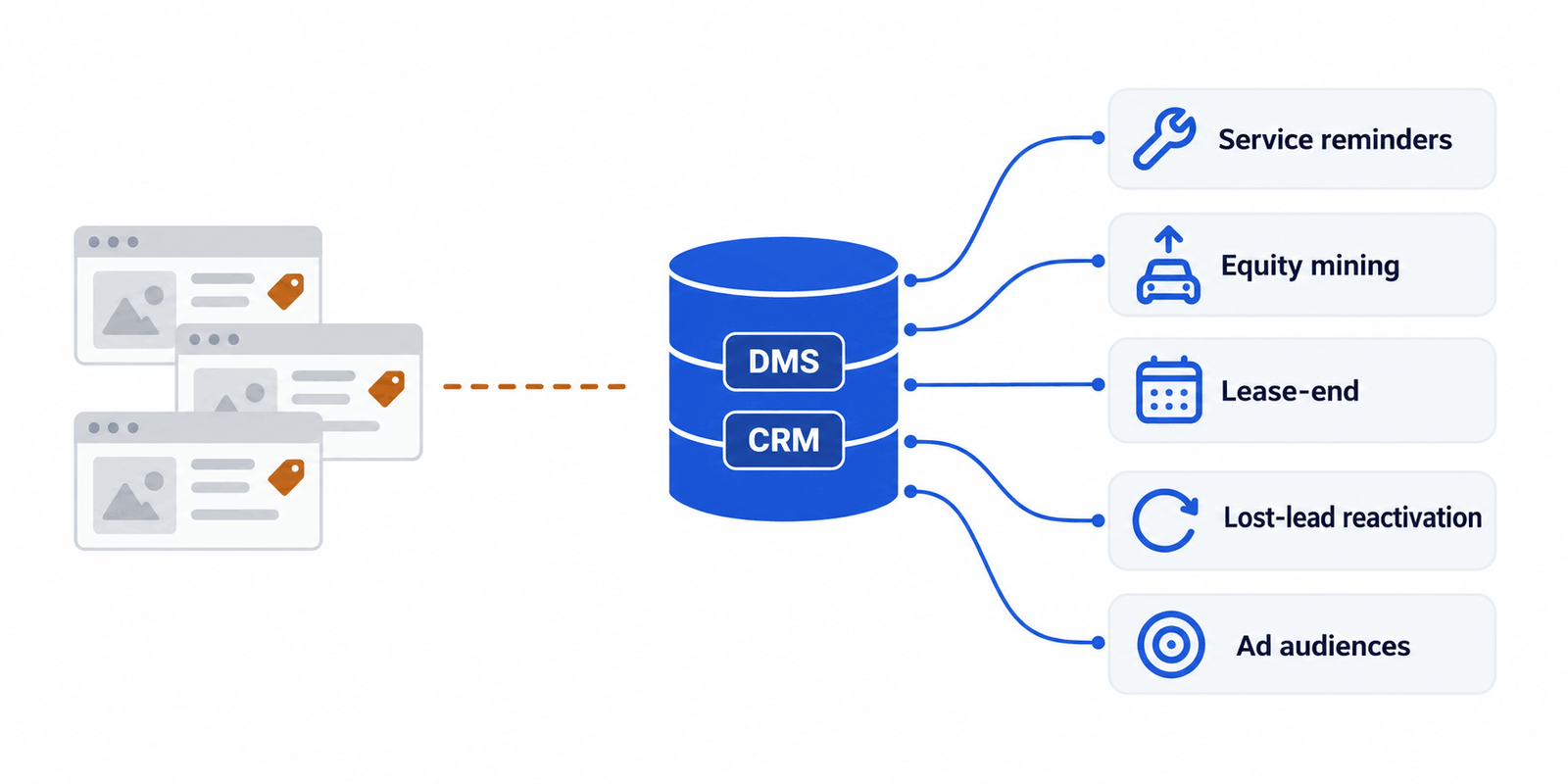
Every past buyer and service customer already sits in your DMS and CRM. That record is your dealership’s first-party data, and it is one piece of your full dealership marketing strategy. Many stores still let that list go cold while the ad budget keeps chasing strangers.
Keep reading for five ways to turn that database into repeat sales this month. Every play runs on the data you already own.
What Counts as Dealership First-Party Data
Dealership first-party data is the customer information your store collects and owns directly, with no third party sitting in between. At a dealership, it lives in four places you already run.
| Where it lives | What it holds | Play it powers |
|---|---|---|
| DMS | Purchases, repair orders, payoff and contract dates | Service reminders, equity mining, lease-end |
| CRM | Calls, texts, emails, test drives, quote requests | Lost-lead reactivation |
| Website and VDPs | Vehicles a known visitor viewed, saved, or priced | Offer matching in every play |
| Trade-in appraisals | Current vehicle value and timing | Equity mining |
Why Your Dealership Database Is the Purest Owned Channel
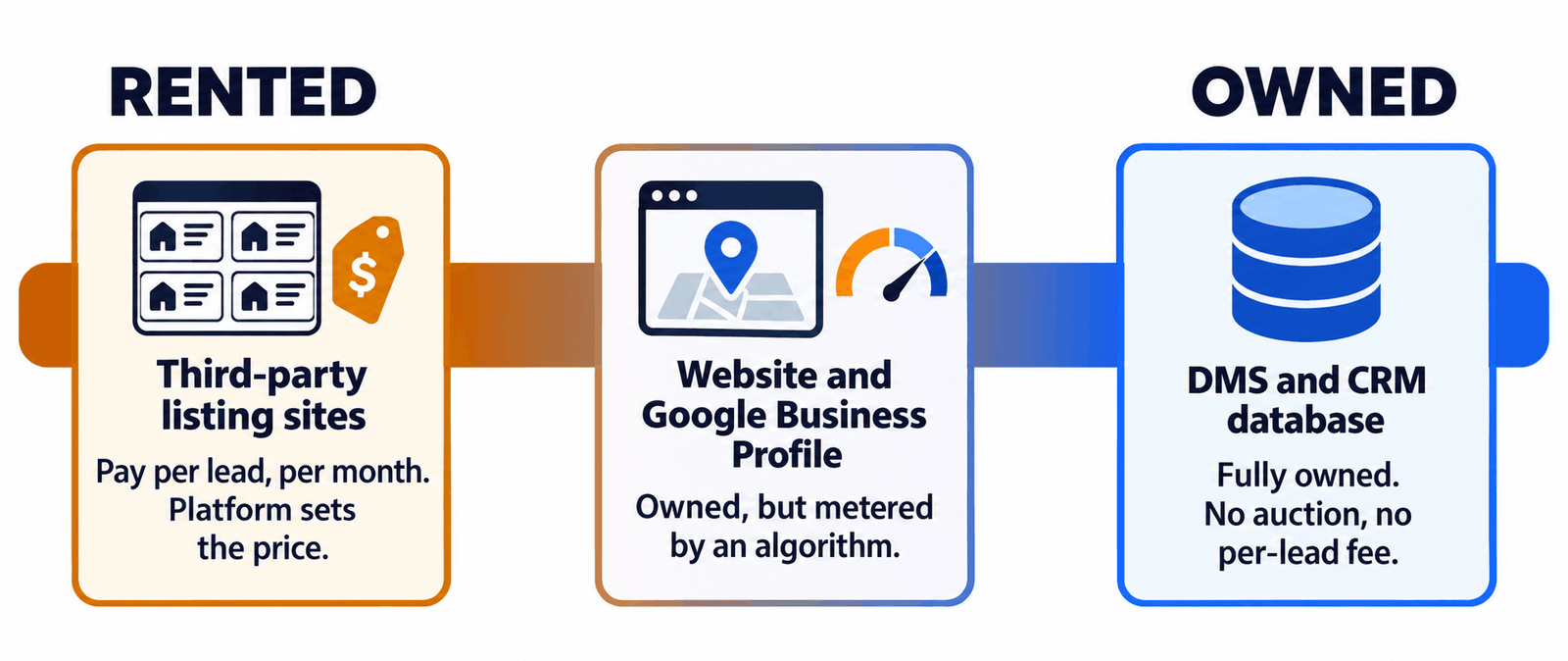
Every marketing channel a dealership uses sits somewhere on the rented-versus-owned budget framework. Third-party listing sites are rented. You pay per lead and per month, and the platform sets the price.
Your own website and Google Business Profile are owned but metered by an algorithm you do not control.
Your database sits at the far end. You fully own it, with no aggregator between you and the customer, no auction setting the price, and no per-lead fee for reaching a buyer you already earned. That ownership is the core of how we approach car dealership marketing.
It also holds up as browsers and regulators keep limiting cross-site tracking, because every record came from your own customers.
First-party data also compounds. Every sale, every service visit, every trade-in appraisal adds another record to a list nobody can auction away from you.
A rented channel resets to zero the day you stop paying. Your database only gets deeper, and the cost of reaching the people on it stays near zero.
Five First-Party Database Marketing Plays for Dealerships
Here are five plays you can run from the data already sitting in your DMS and CRM. None of them needs new software. They are ordered roughly by how forgiving they are of a messy list, so the first two are the place to start.
| Play | Data it uses | When to send |
|---|---|---|
| Service reminders | Last RO date, mileage | When due by time or mileage |
| Equity mining | Payoff, trade value | When equity covers a down payment |
| Lease-end | Contract end date | 90, 60, and 30 days out |
| Lost-lead reactivation | Unsold leads, viewed units | 60 to 120 days after last contact |
| Ad audiences | Sold and repeat-buyer lists | Ongoing |
A note on outreach before the plays: Every email in these plays follows CAN-SPAM basics, with a real postal address, a working unsubscribe, and opt-outs honored within 10 business days. Every text goes only to customers whose CRM record shows prior express written consent, which FCC rules require for marketing texts. Check your consent flags and your state’s rules before any send. [COMPLIANCE]
Service Retention Reminders That Bring Customers Back
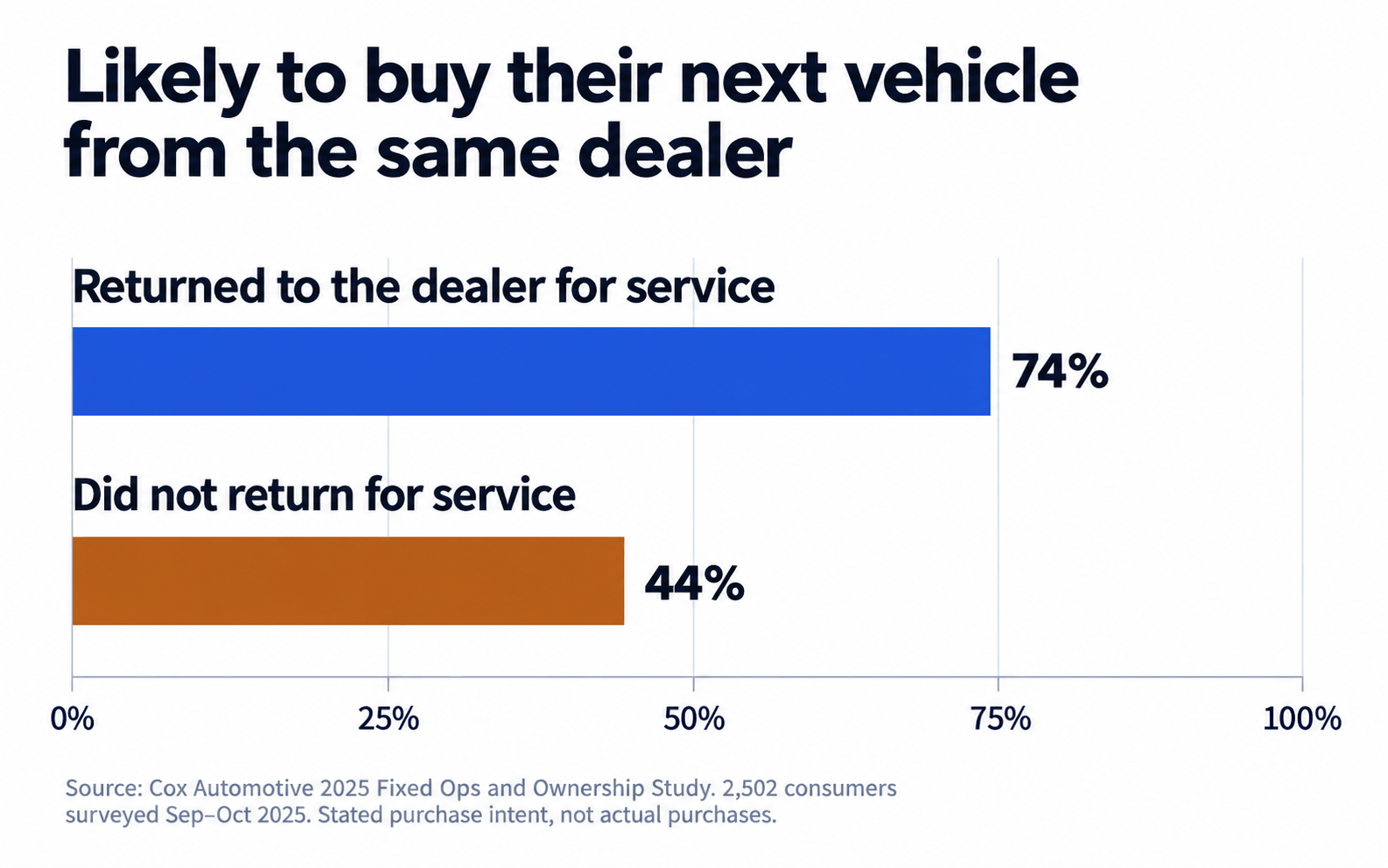
The service lane is where you win the next sale. Cox Automotive’s 2025 Fixed Ops and Ownership Study found 74% of buyers who returned for service said they were likely to buy their next vehicle from that dealership, against 44% of those who did not. The figure measures stated intent from 2,502 consumers surveyed in September and October 2025, and the gap is hard to ignore. Keep a customer in the service bay, and you tend to keep them on the lot.
Service is not a side business either. Across franchised dealers, service and parts ran to $164.6 billion in 2025 on more than 276 million repair orders, a recurring profit center a store reaches almost entirely through its own customer records, according to NADA Data 2025.
Pull every customer with a service visit in the past year and set automated reminders tied to mileage or time since their last visit.
Example: A family bought a used SUV from you last year. They haven’t come back since.
Send them a quick text when their service is due, with a link to book. This brings them back while they’re still your customer. Wait too long, and the quick-lube shop down the road gets them first.
Equity Mining to Turn Current Owners Into Buyers
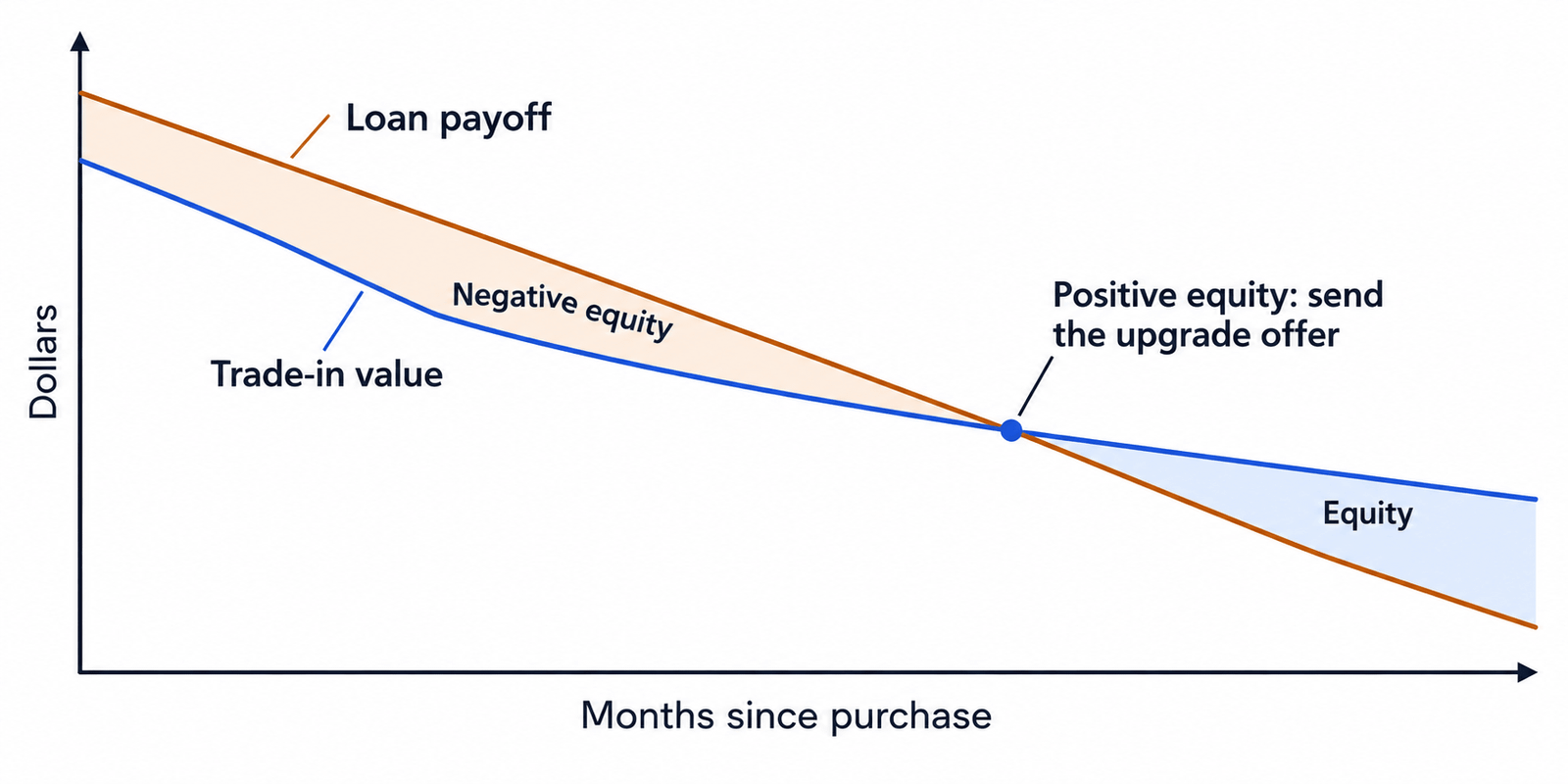
Many financed customers slowly move into positive equity (when their car is worth more than they still owe). Your DMS tracks the payoff, and current market values are easy to pull. When the two line up, you can offer a newer vehicle at a payment close to what they already pay.
Any message that quotes a payment must carry the same credit disclosures your F&I team uses in ads. Under Regulation Z, a stated payment amount triggers disclosure of the down payment, the repayment terms, and the APR. [COMPLIANCE]
Example: A customer financed a sedan three years ago and has paid it down steadily. Its trade value now covers the down payment on a newer model at about the same monthly figure.
That offer needs no new data. The payoff, the original terms, and the vehicle all sit in records you keep. The message is a specific, payment-comparable upgrade offer aimed at one person, which is why it lands.
Lease-End Pipeline Outreach on a 90, 60, 30-Day Cadence
Lease-end is the rare sale you can see coming months out. The contract end date is already in your system, so you can schedule outreach long before the customer starts shopping. Run three touches.
- Around 90 days out: A heads-up that the lease is ending, with a plain summary of the options.
- Around 60 days out: An offer on a specific in-stock model that fits what they drive now. If it names a lease payment, include the Regulation M disclosures. [COMPLIANCE]
- Around 30 days out: A scheduled appointment to make the switch easy.
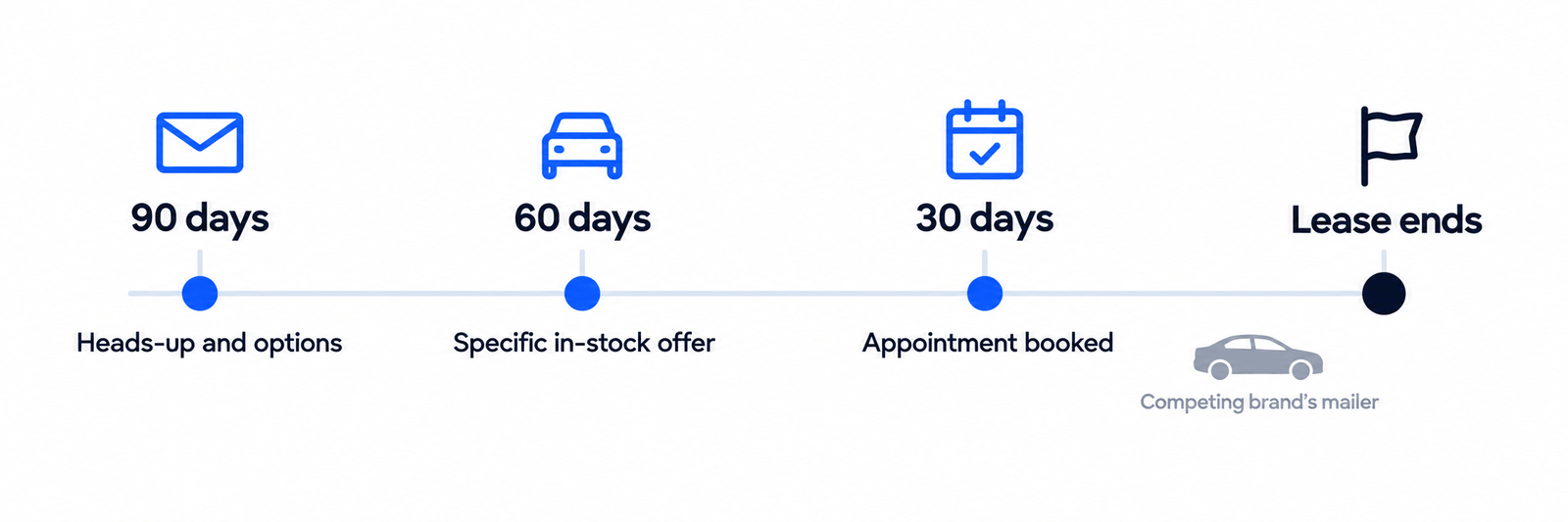
Example: A customer’s lease ends in three months. The 90-day note reaches them before a competing brand’s mailer does, and by the time they would normally start looking, you are already the dealer with an appointment on their calendar.
Lost-Lead Reactivation for Unsold CRM Leads
Leads go quiet all the time. They fill out a form, take a call or two, then stop responding, and they sit untouched in the CRM while the store keeps buying fresh leads to replace them.
In our work, the reactivation window that pays best is leads from about 60 to 120 days ago. They are old enough to have cooled and recent enough that their details still work.
Example: A shopper requested a finance quote three months ago and never came in. A short, direct message asking if they are still looking, paired with a specific unit that matches what they viewed, is often enough to restart the conversation.
First-Party Audiences for Meta and Google Ads
Your customer list does more inside ad platforms than most stores realize. Uploaded as a Customer Match list in Google Ads or a Custom Audience in Meta, it lowers wasted spend in two ways.
- Suppression: Exclude past buyers from your non-finance conquest campaigns so you stop paying to advertise to them.
- Lookalikes: Build a new audience from your best customers so the platform finds more people who resemble them.
Example: Upload your sold-customers list as a suppression audience on your conquest campaigns, then upload your top repeat buyers as the seed for a lookalike.
The same file that stops wasted impressions also sharpens who you reach next.
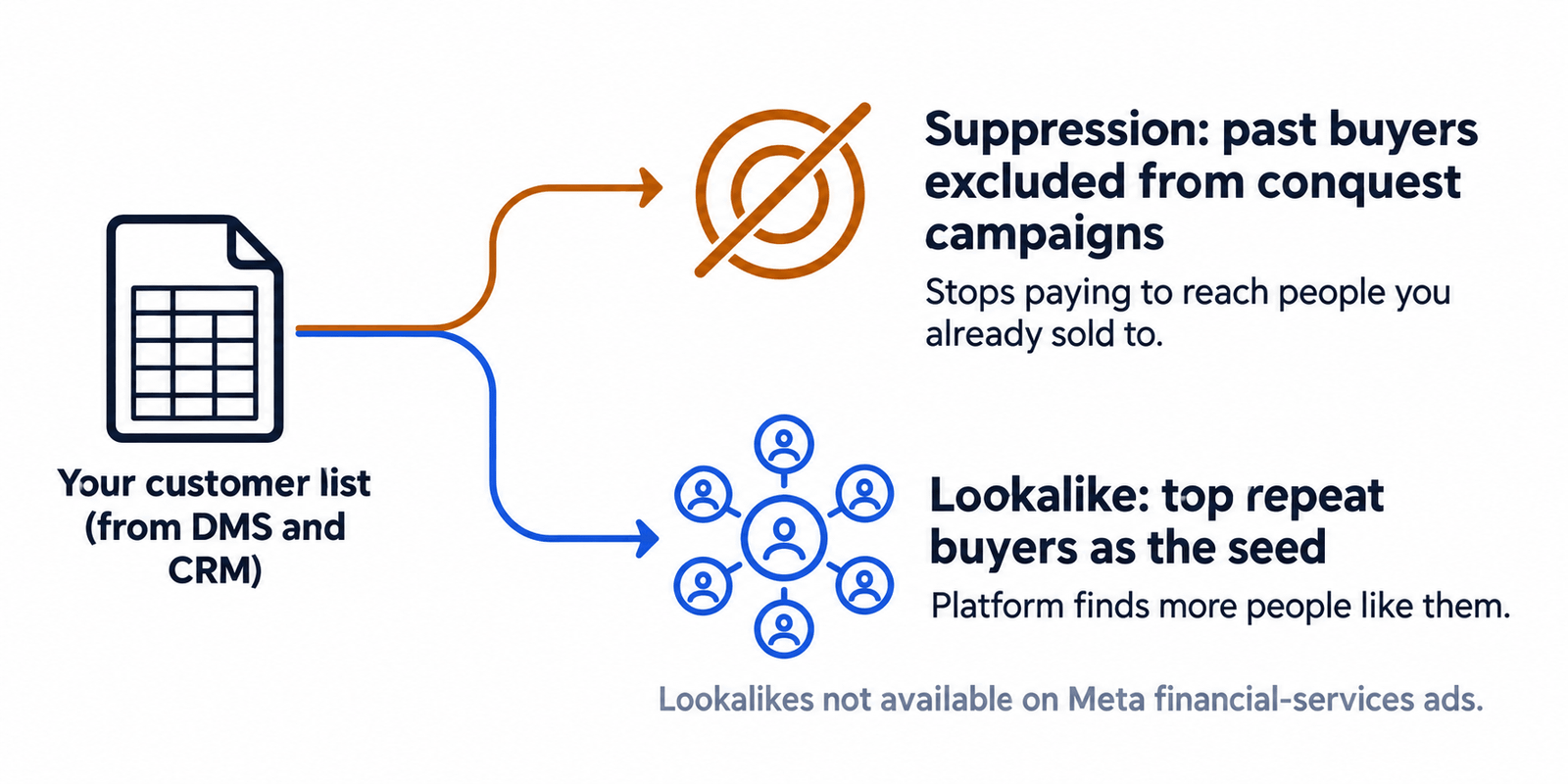
Two platform limits apply. Google offers lookalike segments only in Demand Gen and Video brand campaigns, and Meta does not allow lookalike audiences on ads in its Financial products and services category, which covers loan and financing offers like the equity-mining message above.
Upload only records you are permitted to use under each platform’s customer-data terms and your state’s privacy law. Platform features and names change often, so check the current terms when you build this.
Why Dirty Data Should Not Stop Your Database Marketing
Your list may have bad records. People move, change phone numbers, and switch emails, so part of any customer list goes out of date.
That is normal, and it is not a reason to wait. The first plays in this guide work even if the list isn’t perfect.
Start with the freshest names. Reminders to customers who came in for service this past year and follow-ups to recent leads who didn’t buy reach people whose details you saved most recently. A few wrong entries cost you almost nothing. Save the campaigns that need a clean, sorted list for later.
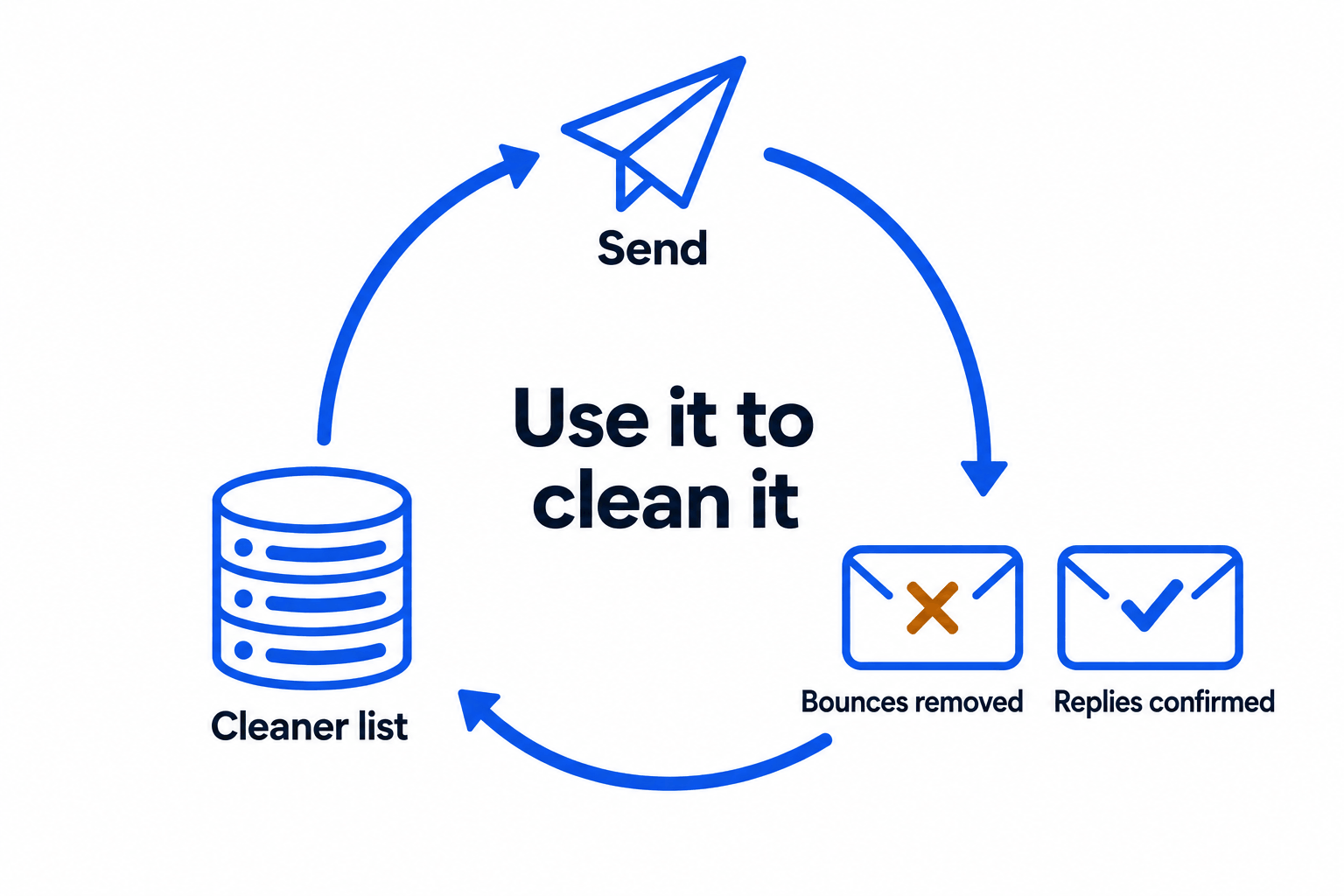
And the list cleans itself as you go. Every email you send shows you which addresses bounce, and every reply confirms a good one. The more you use the list, the better it gets, and you make sales while that happens.
How to Measure Database Marketing Against Your Paid Channels
Measure the database the same way you measure a paid channel, by what it costs to produce a sale. Do that, and it becomes a line item you can defend on the same page as CarGurus, Cars.com, and every other source, often the cheapest one there. Here is the process.
- Tag the source: Give each database campaign its own source code in the CRM, the same way a paid lead gets tagged. Without a tag, the sales it drives get credited to no one or to the wrong channel.
- Count what it produced: Over a set window, say 60 or 90 days, count the vehicle sales and the repair orders that trace back to that campaign.
- Add up what it cost: Total the real cost to run it (your share of the email or text platform plus staff hours). For most database campaigns, this number is small.
- Work out cost per sale and cost per RO: Divide the cost by the sales, and again by the repair orders. Now you have the two numbers every channel gets judged on.
- Line it up against your paid channels: Put that cost per sale next to what each marketplace charges you to produce one. The gap is usually large.
- Move budget, do not add it: Fund the database work by trimming the weakest paid channel, so the store spends the same total and keeps more of the result.
A worked example (illustrative numbers):
You send an equity-mining offer to 500 customers already in positive equity. It costs about $250 in platform fees and staff time and produces 5 attributed vehicle sales.
| Channel | Cost | Sales | Cost per sale |
|---|---|---|---|
| Database campaign | $250 | 5 | $50 |
| Paid marketplace (illustrative) | $4,500 | 5 | $900 |
You produced those five sales for $250, from customers you had already paid to acquire once. Because the offer quotes a payment, the Regulation Z disclosures above apply to it too. [COMPLIANCE]
This is also how you find the money to run these plays in the first place. Put your channels side by side, see which paid sources are losing money, and shift that spend to the database work that outperforms them.
Stop Renting Leads You Can Already Reach for Free
Your dealership first-party data is the one channel you never have to rent. You paid to win every customer in it at least once: service customers, past buyers, and leads that went quiet. Every month you leave that list cold, you pay again for shoppers you could have reached for almost nothing.
The hard part is knowing where the waste is now. That is what our dealership marketing spend audit shows: every channel’s cost per sale side by side, including the database you already own, and which paid source to trim first.
Prefer to talk it through? Book a 30-minute founder call.
FAQs About Dealership First-Party Data
Do Dealerships Need New Software for Database Marketing?
No. Every play above runs on data you already have and tools you already pay for. You can pull a customer list from your DMS or CRM, sort it in a spreadsheet, and send it through the email or text platform your store already uses. In our work, most dealer CRMs can already filter customers by vehicle, make, and model year, so the targeting step needs no new software either.
What Is the Difference Between First-Party, Second-Party, and Third-Party Data?
First-party data comes straight from your own customers, like your DMS and CRM records. Second-party data is another company’s first-party data shared with you, such as owner or lead data your manufacturer shares with you. Third-party data is bought from outside firms that have never dealt with the customer. First-party data is the most direct view of your own customers, and the channel you control most, provided your DMS and CRM contracts let you export it.
Does First-Party Data Marketing Work for Used-Car and Independent Dealers?
Yes. Any store that sells and services cars builds the same records, from buyers to service visits to trade-ins. You do not need a franchise or a manufacturer program to run these plays, just your own DMS and CRM.
What Is Equity Mining at a Car Dealership?
Equity mining is finding customers whose vehicle is now worth more than they owe and offering them a newer one at a similar payment. A dealer pulls the payoff from the DMS, compares it to current trade value, and sends a specific upgrade offer, with full credit disclosures if a payment is quoted.
Sources
- Cox Automotive. “New Cox Automotive Study Finds Dealerships Have Lost 12% of Service Visits to Competition Since 2018” (2025 Service Industry Study). Cox Automotive, November 11, 2025. Accessed October 6, 2026.
- Cox Automotive. “What Dealers Are Leaving in the Service Lane” (2025 Fixed Ops and Ownership Study). Cox Automotive Retail, April 9, 2026. Accessed October 6, 2026.
- National Automobile Dealers Association. “NADA Data 2025: Annual Financial Profile of America’s Franchised New-Car Dealerships.” NADA, 2026. Accessed October 6, 2026.
- Federal Trade Commission. “CAN-SPAM Act: A Compliance Guide for Business.” FTC. Accessed October 6, 2026.
- Federal Communications Commission. “47 CFR 64.1200: Delivery Restrictions.” Electronic Code of Federal Regulations. Accessed October 6, 2026.
- Consumer Financial Protection Bureau. “12 CFR 1026.24: Advertising” (Regulation Z). Electronic Code of Federal Regulations. Accessed October 6, 2026.
- Consumer Financial Protection Bureau. “12 CFR 1013.7: Advertising” (Regulation M). CFPB. Accessed October 6, 2026.
- Google. “Use Lookalike Segments in Video Campaigns to Grow Your Audience.” Google Ads Help. Accessed October 6, 2026.
- Meta. “Special Ad Categories.” Meta Marketing API Documentation. Accessed October 6, 2026.
