 Skip to content
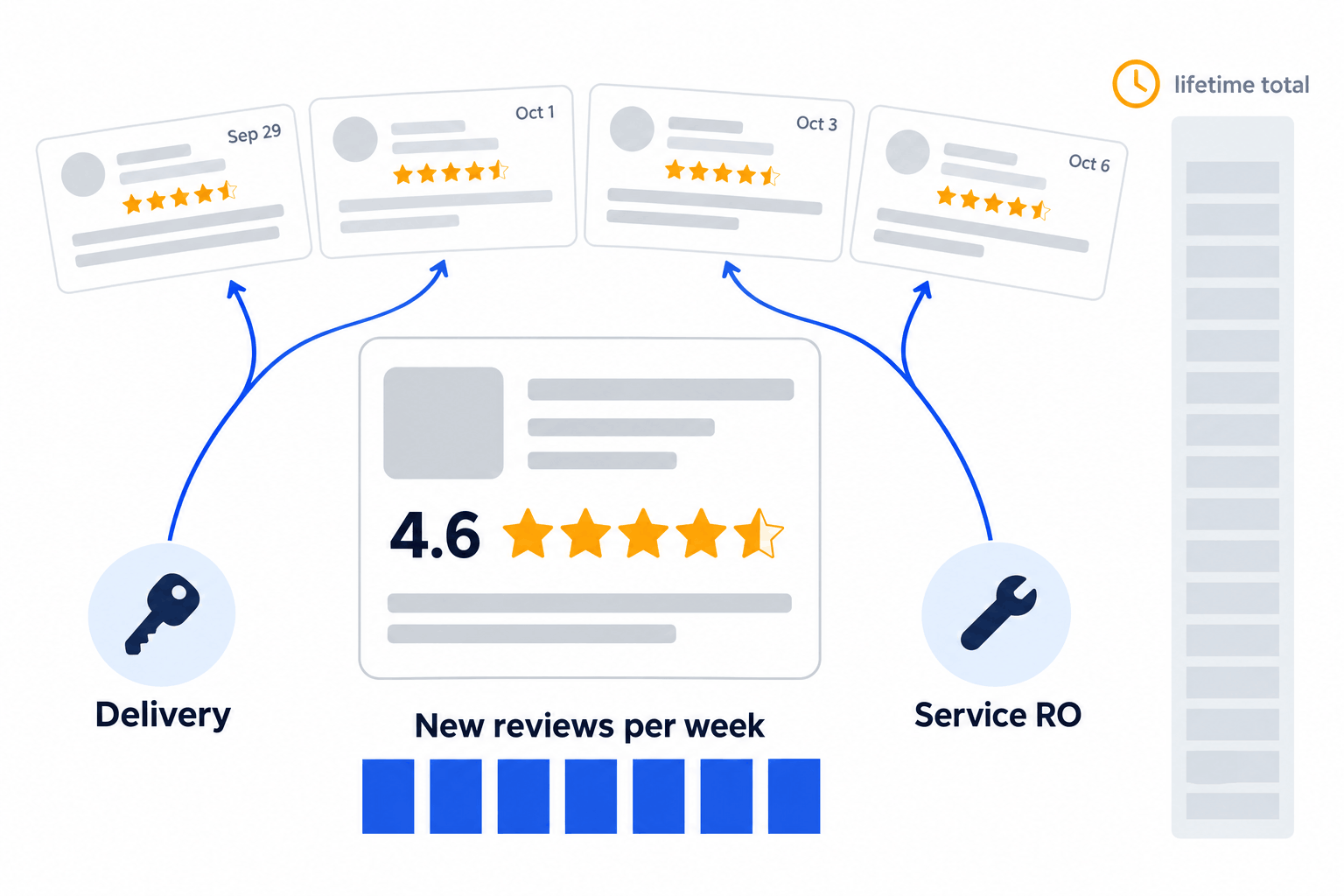
A big lifetime review total can hide a real problem. If the newest review on the profile is six months old, shoppers think that the store has gone quiet.
If you want to know how to get more Google reviews for your dealership in a way that actually moves shoppers, start with velocity.
Review velocity is the steady rate at which fresh reviews arrive, week after week. A store adding a handful of recent reviews every week reads as open, busy, and currently good.
If nothing new comes in for months, shoppers notice the gap first, and a stale profile also gives Google and AI assistants less current information to work with.
This guide will discuss how to get consistent reviews every week on Google Business Profile and other dealership platforms.
Why Review Velocity Outranks Total Google Reviews
Reviews now drive real money before a customer sets foot on the lot. BrightLocal’s 2026 Local Consumer Review Survey found 93 percent of consumers have made a purchase after reading reviews, and more than a quarter spent over $1,000 doing it. A vehicle sits at the far end of that range, which makes the review profile one of the highest-leverage assets a dealership has.
Recency is what keeps that leverage working. The same survey found 74 percent of consumers look for reviews written in the last three months, and 47 percent will not use a business with fewer than 20 reviews at all.
A stale profile with strong lifetime numbers fails that first test before a shopper reads a single word.
Star-rating expectations have also risen sharply in a single year. In 2026, 31 percent of shoppers will only use a business rated 4.5 stars or higher, up from 17 percent the year before, and 68 percent require at least four stars. Only 10 percent hold out for a perfect five, so a natural spread of honest, recent reviews still outperforms chasing a flawless score.
A review system costs little to run, and in our work it is often funded from the aggregator budget a dealer is already trimming.
Pair that velocity with a complete Google Business Profile so every fresh review lands on a profile with accurate hours, photos, and details.
The 5-Step Dealership Reputation Management System
What separates stores that build velocity from stores that stall is whether the ask is a system or a habit. In our work, review volume often rises and falls depending on who happened to be on shift.
Build the five steps below into the process, and the ask stops depending on memory.
The Review Velocity Flywheel
Review Velocity
Trigger the ask on every completed transaction
Deliver a direct, frictionless review link
Pair the verbal ask with a digital follow-up
Respond to every review that comes in
Track ask-completion and new reviews weekly
Trigger Requests on Every Completed Transaction
Send the review request when a transaction is complete. There are two key points to ask. The first is vehicle delivery, and the second is a closed repair order in service.
Service handles many more customer visits than the sales floor handles vehicle deliveries. Franchised dealers wrote more than 276 million repair orders in 2025, according to NADA, far more transactions than vehicle deliveries. Asking only sales customers leaves a large part of the dealership’s review opportunity untouched.
Make the review request a standard final step in both the delivery checklist and the RO close. Every completed transaction should trigger the same request.
Who gets asked matters as much as when. Ask every customer the same way, at the same point in the process. Don’t hold the request back from customers you expect to be unhappy, because Google treats selective solicitation of positive reviews as fake engagement. Resolve open issues through your normal service process, and send the request on its usual schedule. [COMPLIANCE]
Coordinate timing so the review request and any OEM survey do not land on the same day. Check your brand’s CSI survey rules before changing how either one goes out.
Deliver Direct Google Review Links
Friction kills follow-through. Send the customer straight to your Google review form with a short direct link or a QR code, so the review takes two taps instead of a search.
Text message
Hi Jordan, thanks so much for stopping by today! If you had a great experience, it would really help us out if you could leave a quick line or two on Google.
[Direct Google review link]
Delivered
Keep the wording open. Ask for their honest feedback on the experience, and never suggest what to say or which staff member to name. Put the same link in the delivery email, the thank-you text, and on a small card in the glovebox packet.
Use the review link from your Google Business Profile and any free QR code tool to turn it into a card.
Pair Verbal Asks with Digital Follow-Ups
A salesperson or advisor asks in person at handoff, then a short text or email follows within a day with the direct link.
BrightLocal’s 2026 survey found 78 percent of consumers were asked to leave a review in the past year, and 83 percent of the people asked went on to leave one. The ask works.
One clear reminder does most of the work, so do not chase the same customer across five channels.
Respond to All Dealership Reviews
Responding belongs inside the generation system. In BrightLocal’s 2026 survey, 80 percent of consumers said they were likely to use a business that responds to all of its reviews. A fresh, well-answered negative also keeps one bad day from defining the profile. Keep replies brief and human, and respond quickly.
We cover the full reply framework and the five hardest review scenarios in our guide to responding to negative dealership reviews.
Track Weekly Review Generation Metrics
Measurement is what keeps the system running, so track the right things. Watch three numbers weekly, and one of them isn’t a review count.
| Metric | What it measures | Where to pull it | Red flag |
|---|---|---|---|
| Ask-completion rate | Whether staff completed the ask at delivery and RO close | Delivery checklist and RO close sign-off | Low completion, a training and accountability issue |
| New reviews per week | Whether the system is actually producing velocity, by rooftop and platform | Google, DealerRater, Cars.com, or a review-management dashboard | High completion but flat reviews, points to the digital follow-up breaking, not the ask |
| Time from transaction to review | Whether the follow-up lands while the experience is fresh | Sampled monthly, transaction date against review date | A long lag usually means the follow-up step is getting skipped or delayed |
The fastest way to lose the velocity you built is to break a review rule. Two rulebooks apply: federal law and Google’s platform policy, and a single bad vendor can put you on the wrong side of both.
The fastest way to lose the velocity you built is to break a review rule. Two rulebooks apply: federal law and Google’s platform policy, and a single bad vendor can put you on the wrong side of both.
Tracking ask completion is also the compliant way to coach staff. It counts asks, so nobody is chasing a review quota, which Google’s policy prohibits.
FTC Compliance: Prohibited Google Review Tactics
The fastest way to lose the velocity you built is to break a review rule. Two rulebooks apply: federal law and Google’s platform policy, and a single bad vendor can put you on the wrong side of both.
The FTC’s Consumer Review Rule carries the full force of federal law, with civil penalties of up to $53,088 per violation (the 2026 level) for knowing breaches. Google enforces its own policy by removing reviews and suspending profiles, and it expanded those rules in 2026 to cover staff review quotas and requests that name staff members.
Here’s how the main practices line up.
| Tactic | |
|---|---|
| Incentives for a review | Banned for any review, including to revise or remove a negative one |
| Review gating (asking only happy customers) | Banned |
| Scripting content or asking customers to name staff | Banned |
| Pressuring customers to review on the premises | Banned |
| Staff or owner reviews | Banned as a conflict of interest |
| Fake or AI-generated reviews, or suppressing real ones | Banned |
| Staff review quotas | Banned |
[COMPLIANCE]
Multi-Platform Review Generation Strategy
Google should be the first platform you ask customers to review. It gets the most attention from local shoppers, and reviews also support your local SEO efforts and help rank dealership pages.
Keep building reviews on other important platforms too. DealerRater and Cars.com reach shoppers who are already researching dealerships and vehicles there. Cox Automotive’s latest Car Buyer Journey study describes third-party sites as “increasingly the first and last stop” in the vehicle shopping process.
Keep the process simple for each customer. Send one review request to one platform at a time, and do not ask the same customer to review you on Google and DealerRater in the same week.
For example, service customers could receive a Google request while vehicle buyers receive a DealerRater request. Split by transaction type only, never by how happy you expect a customer to be, or the split becomes gated by platform. [COMPLIANCE]
How Dealership Reviews Feed AI Search
A growing minority of car shoppers now ask an AI assistant for dealer recommendations, and those answers draw on review content.
Cox Automotive’s latest Car Buyer Journey study found 19 percent of all vehicle buyers and 25 percent of new-vehicle buyers used AI tools somewhere in the shopping process.
Google’s own guidance on local ranking ties review count and rating directly to prominence, one of the three factors, alongside relevance and distance, that determine whether a business surfaces in local results. Google states that more reviews and positive ratings can help local ranking.
We break down the full mechanism in our guide to how dealerships can get AI recommendations.
Put Review Velocity to Work in a Bigger System
Getting more Google reviews for your dealership comes down to wiring a compliant ask into every completed transaction and keeping it running week after week.
Review velocity is part of a bigger shift: moving off channels you rent and onto channels you own. Reviews and reputation, alongside SEO and AI search visibility, are part of the same owned channel for dealerships.
A strong review profile is also a baseline. Dealers with inconsistent or outdated reviews have more work to do before investing heavily in SEO and AI visibility.
Our free 24-hour visibility audit runs 20 shopper-intent prompts across the major AI engines for your makes, city, and competitors, then shows where your dealership appears.
Prefer to talk it through? Book a 30-minute founder call, no sales scripts.
Dealership Google Review FAQs
How many Google reviews does a car dealership need?
A car dealership should aim for at least 20 Google reviews to start, since 47 percent of consumers in BrightLocal’s 2026 survey won’t use a business with fewer. After that, keep new reviews arriving every week so the profile always looks current.
Can a dealership delete a negative Google review?
A dealership cannot delete a customer’s Google review. You can report a review that breaks Google’s policies, such as spam, a conflict of interest, or content from someone who was never a customer, and Google may remove it.
How long does it take to see results from a review system?
Review volume usually responds quickly once the ask is built into delivery and the RO closes. Any ranking effect is gradual and not guaranteed.
Sources
- Murphy, Rosie. “Local Consumer Review Survey 2026: Star Ratings Keep Rising, Old Reviews Don’t Cut It.” BrightLocal, February 11, 2026. Accessed October 6, 2026.
- Federal Trade Commission. “The Consumer Reviews and Testimonials Rule: Questions and Answers.” FTC, last updated May 1, 2025. Accessed October 6, 2026.
- Google. “Prohibited and Restricted Content.” Google Maps User Contributed Content Policy. Accessed October 6, 2026.
- PPC Land. “Google Tightens Maps Review Policy: Staff Names and Quotas Now Banned.” PPC Land, 2026. Accessed October 6, 2026.
- National Automobile Dealers Association. “NADA Data 2025: Annual Financial Profile of America’s Franchised New-Car Dealerships.” NADA, 2026. Accessed October 6, 2026.
- Cox Automotive. “Cox Automotive Car Buyer Journey Study Finds Efficiency, Digital Tools and AI Drive Record Satisfaction.” Cox Automotive, January 13, 2026. Accessed October 6, 2026.
- Google. “Tips to Improve Your Local Ranking on Google.” Google Business Profile Help. Accessed October 6, 2026.
